Carrier Error Codes Explained for Glendale
Answer up front: Glendale Carrier HVAC decodes Carrier fault codes across all 8 Glendale ZIPs (91201-91208) -- 178/179 are communication faults, 73 points at the run capacitor, 44 is an airflow restriction, and furnace codes 13, 31, and 34 are lockouts -- call (213) 772-7221 or book online to have one read on-site. We confirm each code against the specific model before quoting.
Facts up front
- 178 = indoor comm fault; 179 = outdoor comm fault (Infinity systems).
- 73 = voltage at run cap, no compressor call (some 24/25 condensers).
- 44 = excessive air-delivery restriction; 54 = suction-sensor fault.
- Furnace lockouts: 13 limit, 14 ignition, 26 rollout, 31 pressure switch, 34 ignition proving.
- 180/184/187/286/288 are model/series numbers, NOT fault codes.
- Diagnostic visit $129-$200; most code-driven repairs $150-$2,000.
- Independent shop -- in-warranty units referred to a Carrier dealer first.
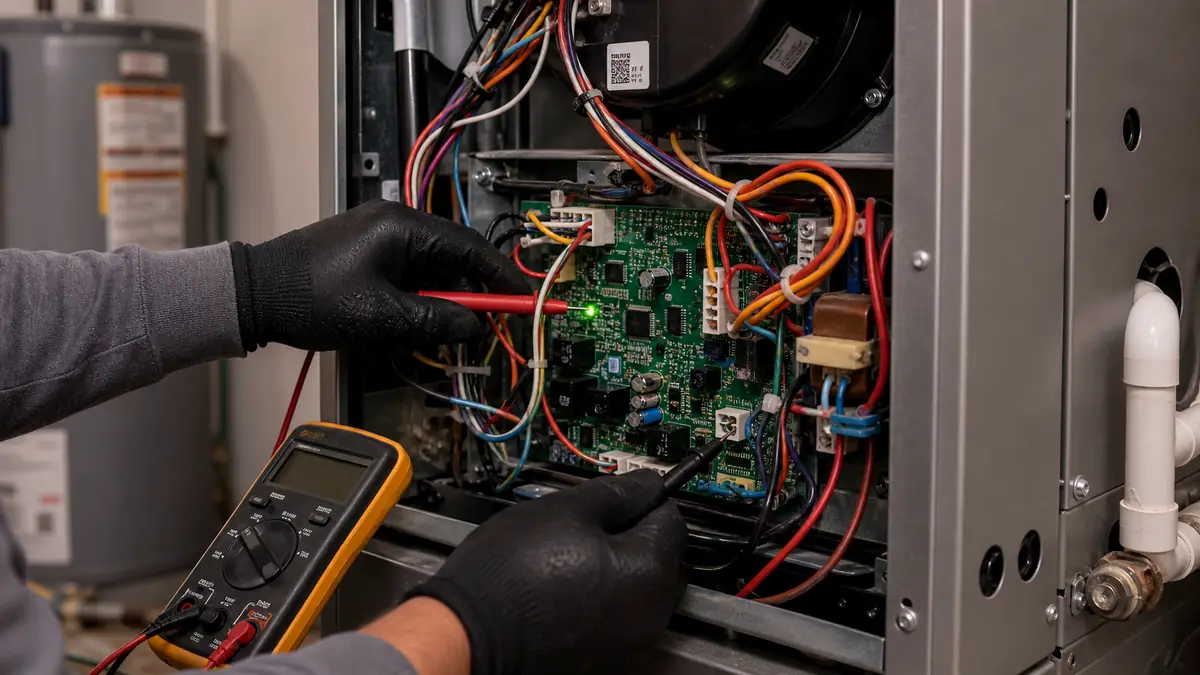
What do the Carrier AC and heat pump codes mean?
On the cooling side, the codes you are most likely to see fall into electrical, refrigerant, and communication groups. Code 73 on some 24- and 25-series condensers means the board senses voltage at the run capacitor but the compressor call is not completing -- a capacitor, contactor, or compressor-circuit issue. Code 44 flags excessive air-delivery restriction, usually a dirty filter or coil or a duct problem common in Glendale's older homes. Code 54 is a suction-temperature-sensor fault, and 56 an outdoor-thermistor problem. Communication codes 178 and 179 are the big two on Infinity systems and almost always trace to the A-B-C-D wiring or a board.
| Code | What it means / first check | Cost lane |
|---|---|---|
| 73 | Run cap or contactor; no compressor call | $150-$450 |
| 44 | Air restriction; filter, coil, ducts | $129-$400 |
| 54 / 56 | Suction or outdoor sensor out of range | $200-$600 |
| 178 | Indoor communication fault; check ABCD bus | $129-$2,000 |
| 179 | Outdoor communication fault; bus or voltage | $129-$2,000 |
What do the Carrier furnace lockout codes mean?
Carrier 59-series and 58-series furnace boards flash a numeric code that names the safety circuit that tripped. Code 13 is a limit-circuit lockout and 33 a limit-circuit fault -- both usually from restricted airflow. Code 31 is a pressure switch that did not close or reopened, pointing at the inducer or a blocked vent. Code 34 is an ignition-proving failure (flame sensor or igniter) and 14 a hard ignition lockout. Code 26 is a rollout switch, which requires a heat-exchanger inspection before anything else, and 24 or 45 indicate a control-fuse or board fault.
| Code | What it means / first check | Cost lane |
|---|---|---|
| 34 / 14 | Ignition proving / hard lockout; sensor, igniter | $150-$400 |
| 31 | Pressure switch; inducer or vent blockage | $200-$700 |
| 13 / 33 | Limit lockout; restricted airflow | $150-$650 |
| 26 | Rollout switch; inspect heat exchanger | $200-$900+ |
| 24 / 45 | Control fuse or circuitry fault | $120-$2,000 |
How do I read a code, and what should I do with it?
Where you read the code depends on the system. On a communicating Infinity setup, the Infinity System Control touchscreen shows the numeric code plus a plain-language line, and it keeps a stored fault history you can scroll -- which is why we pull that log on arrival. On a non-communicating 59-series or 58-series furnace, an amber LED on the control board flashes a two-digit count: count the short flashes for the first digit and the long flashes for the second, so three short plus four long reads as 34. On a non-communicating condenser there is usually no number at all; the fault is found by electrical measurement at the capacitor, contactor, and compressor. Once you have a code, the safe move is to note it and book service rather than repeatedly resetting power -- a code that returns means the underlying fault is still live, and cycling a furnace through repeated ignition lockouts only stresses the board. A code 26 rollout is the one never to reset: it can signal a cracked heat exchanger, and that is a safety inspection, not a reset.
| System | Where the code appears | Example |
|---|---|---|
| Infinity communicating | Touchscreen numeric + plain text + stored history | 178 indoor comm fault |
| 59/58-series furnace | Amber LED flash count on the board | 3 short + 4 long = 34 |
| Non-communicating condenser | No code; electrical measurement | Bad capacitor (metered) |
Why is 187 not a real Carrier code?
It is worth calling out because the error spreads. Numbers like 180, 184, 187, 286, and 288 are outdoor-unit model or series strings -- for example 24ANA "187A" -- not diagnostic fault codes. The legitimate communication faults are 178 (indoor) and 179 (outdoor). If you are reading "187 error" somewhere, you are looking at a model reference. For the components behind these codes, see the Infinity System Control page, and for the specific symptoms jump to AC not cooling, no heat, or short cycling.
Deep dives on two common furnace lockouts
Two of the furnace codes above come up often enough in Glendale that we wrote full walkthroughs for them. Carrier code 33 is a high-limit circuit fault -- the furnace overheats on low airflow and locks out -- and that page covers the filter, blower, and duct causes plus how we measure temperature rise. Carrier code 34 is an ignition-proving failure, almost always a dirty flame sensor reading too few microamps; that page walks the flame-rectification test step by step. Both explain what is safe to check yourself and what costs to expect.
Common questions
Is 180 or 187 a Carrier fault code?
No -- and this trips up a lot of homeowners. Strings like 180, 184, 187, 286, and 288 are Carrier outdoor-unit model or series references (for example 24ANA or 25HNA), not fault codes. The genuine communication fault codes are 178 (indoor) and 179 (outdoor). If a search result calls 187 an error code, it is mixing up a model number.
Where do I read a Carrier fault code?
On a communicating system, the Infinity System Control touchscreen shows the numeric code plus plain-language text. On a non-communicating furnace, an LED on the control board flashes a count -- for example three flashes for a pressure-switch fault. On non-communicating condensers there is often no numeric code, so the fault is found by electrical measurement.
Can I clear a Carrier fault code myself?
You can cycle power to clear a soft lockout, but if the code returns, the underlying fault is still there. Clearing a code 34 ignition lockout without cleaning the flame sensor just delays the next no-heat. We read the code, fix the cause, then confirm the code stays gone under a full operating cycle.
Do all Carrier systems use the same codes?
Mostly within a family. The 178/179 communication codes apply to Infinity communicating systems; the furnace lockout codes (13, 14, 26, 31, 33, 34, 45) apply to 59-series and 58-series boards; and code 73 appears on certain 24- and 25-series condensers. We confirm the code against the specific model rather than assume.