Carrier AC Not Cooling in Glendale
Answer up front: A Carrier AC that runs but will not cool in Glendale, CA (91201-91208) usually has a failed run capacitor or contactor, a low refrigerant charge, a code 44 airflow restriction, or an iced coil -- most fixes run $150-$1,500, so call (213) 772-7221 or book online. Glendale Carrier HVAC diagnoses the real cause before quoting a part.
Facts up front
- Top cause of no-cool: failed run capacitor or contactor, $150-$450.
- Low refrigerant from a leak: ices the coil, $225-$1,500 to repair.
- Carrier code 44 = excessive air restriction (filter/coil/ducts).
- Check thermostat, filter, and float switch before opening the unit.
- Heat-spell priority for foothill no-cool calls.
- Hours: Mon-Fri 7:30am-6:30pm, Sat 8am-4pm.
- Independent shop -- in-warranty units referred to a Carrier dealer first.
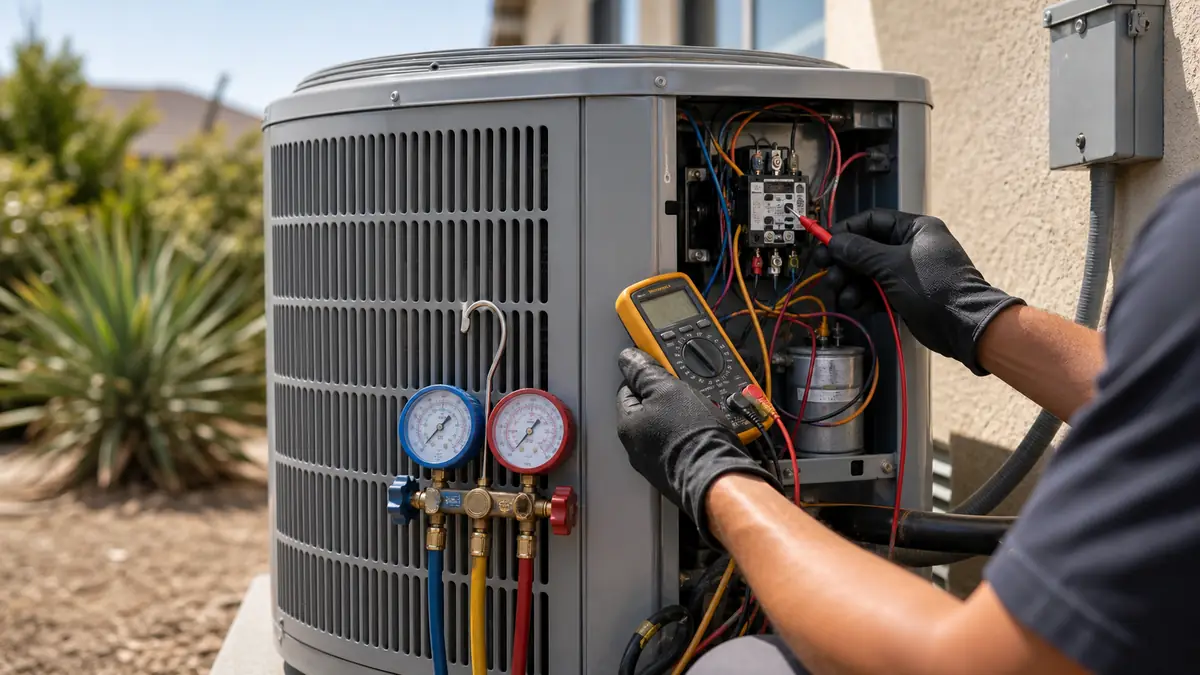
Why is my Carrier AC running but not cooling?
Start with what the outdoor unit is doing. If the condenser hums but the fan and compressor are dead, a failed dual-run capacitor or a pitted contactor is the most common cause -- and the most common AC failure in Glendale's 90 F-plus summers. On some 24- and 25-series units the board logs code 73 for exactly this. If the fan spins but the air stays warm, the compressor is not pumping, often from low refrigerant after a slow flare-joint or coil leak. Low charge ices the indoor coil, which then blocks airflow and makes the cooling worse -- a spiral you can sometimes spot as frost on the copper lines.
| What you see | Likely cause / first check | Cost lane |
|---|---|---|
| Hums, fan dead, warm air | Run capacitor or contactor (code 73) | $150-$450 |
| Fan spins, still warm | Low refrigerant; pressure-test for leak | $225-$1,500 |
| Frost on coil/lines, weak air | Iced coil; airflow or charge | $129-$1,500 |
| Long runtime, code 44 | Dirty filter/coil; clean first | $129-$400 |
| Nothing runs at all | Thermostat, float switch, breaker, board | $129-$900 |
How does a tech diagnose a Carrier no-cool, step by step?
The order matters because it moves from cheap and common to expensive and rare. First we watch the condenser on a cooling call: does the contactor pull in, does the fan spin, does the compressor start? A hum with a dead fan sends us to the dual-run capacitor, which we meter against its rating -- a 45/5 cap reading 30 microfarads is failed. Second, we inspect the contactor for pitting and check it pulls in clean. Third, if the electrical side is healthy but the air stays warm, we connect gauges and read suction and head pressure, then take a temperature split across the indoor coil; a healthy split is about 16-22 F, and a low split with low suction pressure says low refrigerant from a leak. Fourth, we check airflow -- a clogged filter or fouled coil throws Carrier code 44 and ices the evaporator. Fifth, on an Infinity system we pull stored fault history (44, 54, 56, or a 178/179 comm fault) from the Infinity System Control. Only after that measured sequence do we name a part and a price, so you are not paying for a guess.
That same sequence tells us when no-cool is really a different problem wearing a disguise. A tripped condensate float switch opens the cooling call and reads as no-cool until you find the water; a thermostat that lost its link to the Infinity control does the same. Working the checks in order keeps a $129 drain clear from being misquoted as a $1,500 refrigerant job.
What can I check before I call?
A few safe checks save a service call. Confirm the thermostat is in cool and set below room temperature; on an Infinity system, make sure it has not dropped a connection to the Infinity System Control. Replace a dirty filter -- restricted airflow is Carrier code 44 and a frequent cause of weak cooling and coil icing. Check whether a condensate float switch has tripped (water in the pan). If the coil is frosted, switch the system to fan-only to thaw it before we arrive. Anything past that -- electrical readings, refrigerant pressures -- needs gauges and meters.
When is no-cool an emergency?
During a Glendale heat spell, a full no-cool in a foothill home that holds evening heat is worth treating as urgent -- see emergency AC repair. For the underlying repair work, the Carrier AC repair page covers capacitors, refrigerant, and coils, and the fault-code reference explains codes 44, 54, and 73. If the system also short-cycles, see AC short cycling.
Common questions
My Carrier AC runs but blows warm air -- what is wrong?
Warm air from a running system usually means the compressor is not engaging (a failed capacitor or contactor) or the refrigerant charge is low from a leak. On a Glendale 95 F afternoon you feel it fast. Check that the outdoor fan and compressor are actually running; if the fan spins but the air stays warm, the compressor side is the likely culprit.
Why does my Carrier coil keep freezing up?
A frozen indoor coil comes from low airflow or low refrigerant. The fix order matters: replace a clogged filter and clean the coil first, since restricted airflow (Carrier code 44) is the cheapest cause. If airflow is fine and it still freezes, you have a refrigerant leak that needs to be found and repaired, not just topped off.
Could my thermostat be why the Carrier AC is not cooling?
Sometimes. A miswired or failing thermostat, or on an Infinity system a lost connection to the Infinity System Control, can stop a cooling call. We rule out the simple stuff -- thermostat settings, a tripped float switch, a dirty filter -- before opening up the condenser, because the cheap causes are common.
How fast can you get cooling back during a Glendale heat spell?
Most no-cool calls are a capacitor or contactor we carry on the truck, so we often restore cooling the same visit. Call early in a heat wave and flag it as a full no-cool; Glenoaks Canyon and upper Verdugo Woodlands get priority because those pockets hold heat into the night.