Carrier Heat Pump Repair in Glendale
Answer up front: Glendale Carrier HVAC repairs Carrier heat pumps across Glendale, CA (91201-91208), from Verdugo Woodlands to El Miradero, handling reversing valves, defrost controls, inverter boards, and 178/179 communication faults on Infinity and Performance units, with repairs spanning $129 to $3,500; call (213) 772-7221 or book online for a same-week diagnosis.
Facts up front
- Covers Infinity 25VNA4/27VNA3/27VNA1 and Performance 27VPA9/27TPA8 heat pumps.
- Comm faults 178 (indoor) / 179 (outdoor) traced at the A-B-C-D bus first.
- Capacitor/contactor $150-$450; inverter or control board $400-$2,000.
- Inverter compressor (variable-speed) $1,200-$3,500.
- Diagnostic $129-$200, credited toward an approved repair.
- Hours: Mon-Fri 7:30am-6:30pm, Sat 8am-4pm.
- Independent shop -- in-warranty units referred to a Carrier dealer first.
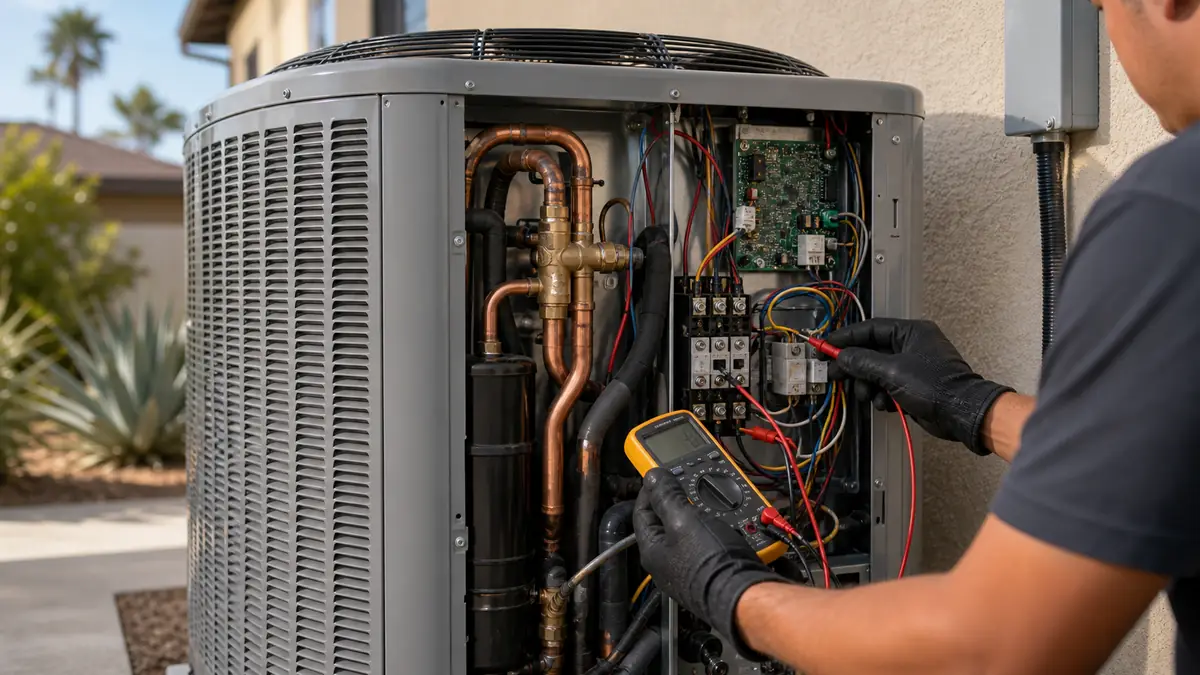
Why is my Carrier heat pump not heating in Glendale?
Glendale winters are mild, so a healthy heat pump should warm a home with ease. When it cannot, the usual suspects are a reversing valve that is stuck or not shifting on its solenoid call, a defrost-control fault, a low refrigerant charge from a flare-joint leak, or the system dropping out of variable-speed because the Infinity System Control lost communication. We start with the stored Infinity fault history, check the reversing valve operation, and verify refrigerant pressures against the nameplate rather than guessing.
| Symptom | Likely cause / first check | Cost lane |
|---|---|---|
| Runs in cooling but not heating | Stuck reversing valve or solenoid | $300-$1,200 |
| Outdoor unit ices, weak heat | Defrost control or sensor; refrigerant | $225-$1,500 |
| Reverts to single speed | Comm fault 178/179 or inverter board | $400-$2,000 |
| Hums, no start | Capacitor or contactor | $150-$450 |
| Repeat inverter faults, old unit | Inverter compressor; weigh replace | $1,200-$3,500 |
| Outdoor unit silent, no start | Condenser fan motor or its capacitor | $300-$900 |
| Water at indoor coil, shutdown | Clogged condensate drain or pump float | $129-$450 |
How does a Carrier heat pump repair go, step by step?
A heat pump adds parts an AC does not have -- a reversing valve, defrost controls, and on Infinity units an inverter -- so the diagnosis follows a heating-aware order. First we read the Infinity touchscreen fault history or, on a non-communicating Performance unit, confirm the call electrically. Second, we settle which mode fails: a unit that cools fine but will not heat points straight at the reversing valve or its solenoid, while one that struggles in both modes points at refrigerant, the compressor, or airflow. Third is the electrical bench check -- capacitor microfarads, contactor points, condenser fan motor, and on a variable-speed unit the inverter drive and the A-B-C-D communication bus. Fourth, the refrigerant side: gauges on the ports to read pressures, superheat, and subcooling, since a flare-joint leak is the classic slow drain. Fifth, for a no-defrost complaint we watch a defrost cycle and check the defrost thermostat and outdoor-coil sensor. Then a written price, the fix, and verification -- we confirm the reversing valve shifts cleanly, the temperature split is right, and any stored code clears.
The instruments are the same family as an AC call plus a close eye on the defrost logic: a multimeter and clamp ammeter for the electrical, a micron gauge and recovery machine for refrigerant work, and the touchscreen history that makes an Infinity diagnosis far quicker than guesswork.
Which Carrier heat pump models do you repair?
The whole residential range. On the Comfort value tier the single-stage 27SCA5 is a straight electrical diagnosis. The Performance tier covers the single-stage 27SPA6, the two-stage 27TPA8 (Performance 18), and the variable-speed 27VPA9 (Performance 19) with InteliSense. The Infinity Greenspeed tier is the 27VNA0 (Infinity 20), 27VNA3 (Infinity 23), the cold-climate 27VNA1, and the recent flagship 25VNA4 (Infinity 24) reaching roughly 22 SEER2 and 10.5 HSPF2. The key repair difference: Comfort and Performance two-stage units are read with a meter, while the variable-speed 27VPA9 and the whole Infinity line depend on the Infinity System Control and an inverter drive, so they surface numeric codes (44, 54, 56, 178, 179) but carry pricier boards. We see the cold-climate 27VNA1 occasionally in Glendale even though Zone 9 rarely needs it -- usually installed by a prior owner who over-specified.
What does heat pump repair cost in Glendale and why?
The band is $129 to $3,500, and where you land depends on the part. The diagnostic is $129-$200, credited toward an approved repair. Shared electrical wear -- capacitor, contactor, condenser fan motor -- runs $150-$900, identical to an AC. Heat-specific parts cost more: a reversing valve or its solenoid is $300-$1,200 because it sits in the refrigerant circuit and often needs recovery and recharge, and a defrost board or sensor is $225-$700. Refrigerant leak repair with recharge is $225-$1,500. The two big-ticket items are an Infinity communicating or inverter board at $400-$2,000 and a variable-speed inverter compressor at $1,200-$3,500 -- the figure that usually tips an older unit toward replacement. The Glendale-specific cost drivers are the premium parts on the Infinity tier and the refrigerant phasedown pushing R-410A prices up each season.
How do you diagnose Infinity communication faults?
Codes 178 and 179 stop a lot of techs cold, but the fix is often cheap. We meter the A-B-C-D communication bus for continuity and voltage, check the connections at both the indoor and outdoor boards, and confirm line voltage to the condenser. Glendale's older homes sometimes have comm wiring run alongside line-voltage runs or pinched in a retrofit, which corrupts the signal. A wiring repair is a fraction of a board swap, so we rule that out before recommending the Infinity System Control or a control board. The full code list lives on the Carrier fault-code page.
When does a heat pump make more sense to replace?
A dead inverter compressor on a variable-speed unit past ten years is the classic tipping point: with the compressor alone running $1,200-$3,500, a new system usually pencils out better. The same threshold holds on any 10-to-12-year-old heat pump -- once the fix would cost half of a replacement, the lean is toward swapping it. When a Glendale unit lands there, we price a Carrier heat pump installation and check whether an LADWP or SCE rebate happens to be open at the time. If it does not, we repair it and move on.
Common questions
My Carrier heat pump runs but barely warms the house -- why?
On a Greenspeed Infinity or Performance heat pump, weak heat usually traces to a stuck reversing valve, a defrost-control fault, low refrigerant, or the system dropping out of variable-speed because the Infinity control lost communication. Glendale winters are mild, so a heat pump should keep up easily; when it cannot, we check the reversing valve solenoid and the stored Infinity fault history first.
What does code 178 or 179 mean on my Carrier heat pump?
Those are communication faults: 178 is an indoor-unit comm fault and 179 is an outdoor-unit comm fault on Infinity systems. They usually point to damaged or loose A-B-C-D communication wiring, a water-damaged control board, or lost line voltage to the outdoor unit. We trace the comm bus before condemning a board, since a $40 wiring repair beats a $1,200 board swap.
Is heat pump repair more expensive than AC repair?
It can be, because heat pumps add a reversing valve, defrost controls, and on Infinity units an inverter board. Simple faults like a capacitor or contactor are the same $150-$450 as an AC. Inverter or communicating board work runs $400-$2,000, and a failed inverter compressor on a variable-speed unit can reach $1,200-$3,500 -- the point where repair-vs-replace matters.
Do you repair the variable-speed Infinity heat pumps?
Yes. We diagnose the 25VNA4, 27VNA3, and 27VNA1 cold-climate units, including the Infinity System Control that unlocks their modulation. When a variable-speed unit reverts to single-speed, it is almost always a comm or board issue rather than a dead compressor, and we confirm that before quoting.
My Carrier heat pump's outdoor unit runs constantly but ices over -- what is it?
An outdoor coil that frosts and never clears points to a defrost-control fault, a failed defrost thermostat or outdoor-coil sensor, or a low refrigerant charge. The heat pump is supposed to reverse briefly into cooling to melt frost off the outdoor coil; when that cycle fails, ice builds and heating output collapses. We check the defrost board logic and the sensor readings, then confirm refrigerant pressures against the nameplate before replacing anything.
Can a Carrier heat pump and a gas furnace share a system in Glendale?
Yes -- that dual-fuel or hybrid setup is common on Glendale conversions. The heat pump handles cooling and most of the mild winter heating efficiently, and the existing gas furnace acts as backup on the few cold mornings. The Infinity control manages the changeover. When we repair one of these, we verify the changeover setpoint and that both the heat pump and the furnace stages are firing in the right order.