Carrier HVAC Maintenance Calendar for Glendale
Last updated: 2026-06-13
Answer up front: A Carrier system in Glendale, CA (91201-91208) needs a spring cooling tune-up before the first 90 F week and a fall furnace check before real runtime, plus filter changes every 1-3 months -- call (213) 772-7221 or book online to schedule both. Glendale Carrier HVAC tunes this calendar to cooling-dominant Climate Zone 9.
Facts up front
- Glendale is cooling-dominant Title-24 Climate Zone 9 -- spring AC service is priority one.
- Glendale sees roughly 35-50 days a year at or above 90 F.
- Two professional visits a year: spring cooling, fall heating.
- Filter change every 1-3 months; condensate flush each cooling season.
- Foothill homes (Glenoaks Canyon, Rossmoyne) run hotter -- service earlier.
- Pre-summer capacitor/coil check prevents most July no-cool calls.
- Independent shop -- in-warranty units serviced by an authorized dealer first.
Why does Glendale's climate set the maintenance schedule?
Glendale sits in Title-24 Climate Zone 9, the cooling-dominant inland zone, and the Verdugo Mountains add a wrinkle: the foothills trap heat, so Glenoaks Canyon, upper Verdugo Woodlands, and Rossmoyne run hotter than the flatland and hold that heat into the evening. With roughly 35 to 50 days a year above 90 F, the air conditioner does far more work than the furnace, and its parts wear on that schedule. That is why the calendar below front-loads the cooling system in spring. The furnace matters too, but it runs a short season, which ironically makes its first cold-night failures more common because the ignition parts sit idle and gather dust.
The maintenance goal is simple: catch the cheap wear items -- a weakening run capacitor, a dirty coil, a clogging condensate drain -- before a 95 F afternoon turns them into an emergency. Below is a month-by-month plan for a Carrier system in Glendale, followed by what each professional visit actually includes.
What should I do each month and season?
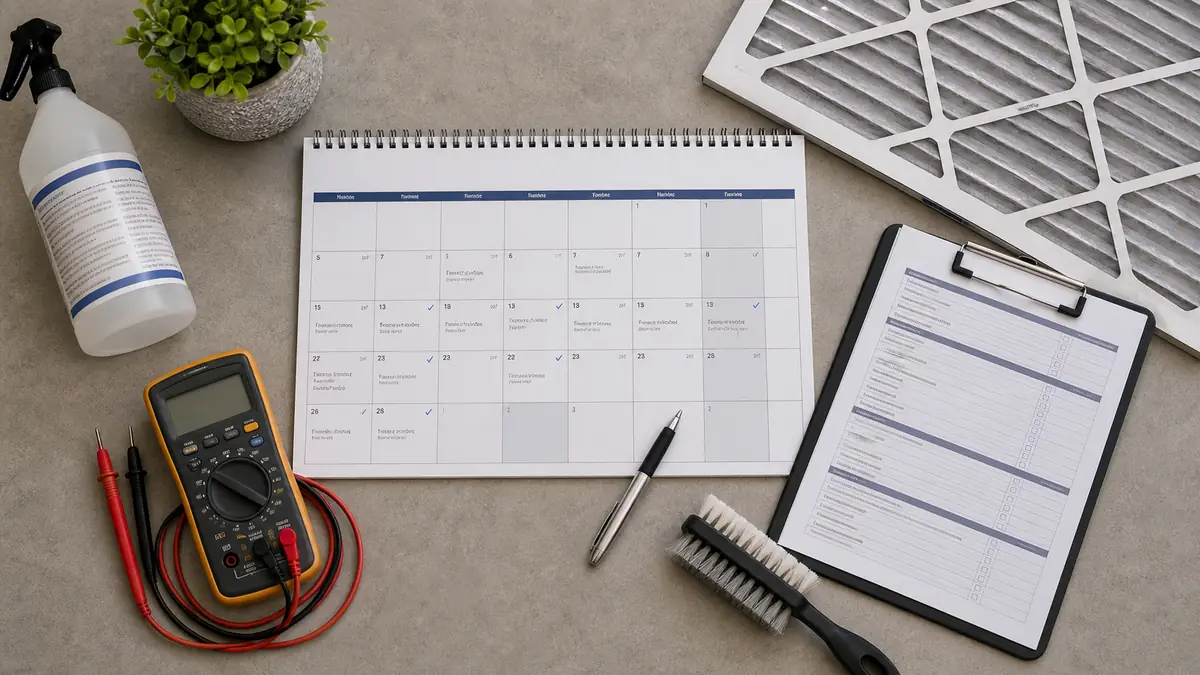
The heaviest lifting happens in spring, ahead of the heat. The fall visit is lighter but protects against a no-heat surprise on the first cold night. Homeowner filter and condensate tasks fill the gaps.
| Window | Task | Who |
|---|---|---|
| Mar-Apr | Pre-summer cooling tune-up: capacitor test, coil clean, charge check, condensate flush | Pro |
| May | Replace filter; clear 2+ ft around the outdoor condenser | Owner |
| Jun-Aug | Filter check monthly in peak cooling; watch for weak airflow or icing | Owner |
| Jul | Foothill homes: mid-season condensate-pan and drain check | Owner/Pro |
| Sep-Oct | Fall heating check: flame sensor, igniter, inducer, pressure switch, heat exchanger look | Pro |
| Nov | Replace filter before steady furnace runtime | Owner |
| Dec-Feb | Listen for short-cycling or delayed ignition on cold nights | Owner |
What does each season actually demand in Zone 9?
The calendar above is the quick read; here is the reasoning season by season, tuned to Glendale's cooling-dominant climate and its foothill heat pockets.
Late winter into spring (Feb-Apr) is the most important window. This is when the pre-summer cooling tune-up happens, before the first 90 F week catches a marginal part. We test the run and start capacitor microfarads against the data-plate rating, because a capacitor drifting low survives a mild April and dies on a 96 F July afternoon. We clean the condenser coil so it can actually reject heat -- a job that matters more here than at the coast because the unit will run hundreds of cooling hours -- and verify the refrigerant charge and the temperature split. Foothill homes in Glenoaks Canyon, upper Verdugo Woodlands, and Rossmoyne should book early in this window; they run hotter and hold heat past sunset, so they reach failure load sooner than the flatland.
Summer (May-Sep) is homeowner-maintenance season. Change or check the filter monthly through peak cooling, keep the outdoor condenser clear of leaves and shrubs by at least two feet, and watch for the early-warning signs -- weak airflow, frost on the copper lines, or a unit that short-cycles. A mid-July condensate-pan and drain check pays off on attic and closet units, where a clogged line overflows during the heaviest run weeks. Catching a dirty filter (Carrier code 44) in June prevents the iced coil and no-cool that the same neglect produces in August.
Fall (Sep-Oct) shifts to the heating side. Glendale's heating season is short, which ironically makes the first cold night the most failure-prone, because the ignition parts have sat idle and gathered dust since spring. The fall visit cleans and tests the flame sensor, checks the hot-surface igniter, verifies the inducer and pressure switch, and takes a look at the heat exchanger -- the checks that head off a code 34 ignition lockout on the first 45 F morning.
Winter (Nov-Feb) is light-touch monitoring. Replace the filter before steady furnace runtime in November, then listen on cold nights: a furnace that lights and drops out, delays ignition, or short-cycles is telling you the flame sensor or igniter is on its way out, and it is far cheaper to handle before it strands you at the coldest hour.
What does a Carrier cooling tune-up include?
A real spring tune-up is more than a glance. We measure the run and start capacitor microfarads against spec (a cap reading low is on its way out), inspect the contactor for pitting, and check compressor and fan amp draw. We clean the condenser coil so it can reject heat -- critical in Zone 9 -- verify the refrigerant charge and the temperature split across the indoor coil, and flush the condensate drain and test the float switch. On Infinity systems we pull the stored fault history from the Infinity System Control to catch a brewing 178/179 comm issue before it strands you. Catching a marginal capacitor in April for a small part cost beats an emergency call in July.
| Tune-up check | Failure it heads off | Emergency cost avoided |
|---|---|---|
| Capacitor microfarad test | Mid-summer no-cool | $150-$450 |
| Coil clean + charge check | Iced coil, weak cooling (code 44) | $225-$1,500 |
| Condensate flush + float test | Water damage, shutdown | $129-$500 |
| Fall ignition-train check | First-cold-night no-heat (code 34) | $150-$400 |
What does a Carrier fall heating check include?
The fall visit is shorter than the spring tune-up but it is the one that prevents a no-heat surprise. On a 59-series or 58-series Carrier furnace we clean and test the flame sensor with a microamp reading -- a flame-rectification signal below spec is the single most common no-heat cause after an idle summer, and a light sanding often restores it. We inspect the hot-surface igniter for cracks and check its resistance, verify the inducer spins up and closes the pressure switch, and confirm the high-limit and rollout switches are intact. We look at the heat exchanger for any sign of a crack, because a compromised exchanger is a safety red-tag, not a repair. On an Infinity system we pull the stored fault history from the Infinity System Control so a brewing code 31 or 34 surfaces in October rather than on a January night. The point is to clear the dust-and-idle failures while they are a $150-$400 part, not a midnight emergency.
How does maintenance tie into Title-24 and efficiency?
Maintenance keeps a Carrier system at the efficiency it was rated for, which matters more in Zone 9 because the AC runs so many hours. A dirty coil or a low charge quietly drops capacity and raises your bill long before it fails outright. Should a repair tip over into a replacement, bear in mind that California Title-24 in Climate Zone 9 generally calls for refrigerant-charge and airflow verification on new split systems, plus HERS duct-leakage testing on most duct alterations -- which is its own reason to keep the existing system tuned rather than rush an early changeout. The Carrier buying guide covers the replacement and rebate picture; for active faults, see AC not cooling or furnace not heating.
Does a foothill home need a different schedule than the flatland?
Yes, by a few weeks and a bit more attention. The Verdugo Mountains and Verdugo Wash trap afternoon heat against the slope, so Glenoaks Canyon, upper Verdugo Woodlands, and Rossmoyne run hotter than the flatland near the Galleria and hold that heat into the evening. The practical effect is more compressor runtime over the season, which wears the run capacitor and contactor faster and pushes a marginal part to failure sooner. So foothill homes should book the spring cooling tune-up earlier -- February into early March rather than April -- and pay closer mid-summer attention to the condenser coil, which collects more debris on shaded canyon lots under heavy tree cover. Hillside-mounted and rooftop condensers common up there also bake in direct afternoon sun, so a clean coil and a verified charge matter even more for keeping capacity from sagging on the worst days. Flatland homes on tight lots have their own wrinkle: condensers crammed into narrow side yards starve for airflow, so clearing the two-foot envelope around the unit is not optional there.
What can a Glendale homeowner do between visits?
Plenty, and it all helps. Change the filter on schedule -- every one to three months depending on type and pets. Keep the outdoor condenser clear of leaves, clippings, and shrubs by at least two feet so it can breathe; this is easy to forget on shaded foothill lots in Verdugo Woodlands. With the power off at the disconnect, gently rinse the condenser coil from inside out with a hose. Pour the recommended condensate treatment down the drain line each cooling season to slow algae. Leave electrical, refrigerant, and combustion work to a technician. When you want the professional visits done, book a service appointment or call the dispatch desk.
The bottom line: a Glendale Carrier checklist
If you do nothing else, do these in order of payoff for a Zone 9 home.
- Book a pre-summer cooling tune-up in Mar-Apr; this is the single highest-value task, since it catches the capacitor and coil issues that cause most July no-cool calls.
- Change the filter every 1-3 months -- monthly through peak summer -- to prevent code 44 restriction and coil icing.
- Keep two feet clear around the outdoor condenser; rinse the coil gently with the power off at the disconnect.
- Flush the condensate drain each cooling season and check the pump on attic and closet units.
- Book a fall heating check in Sep-Oct so the flame sensor and igniter are clean before the first cold night.
- Foothill homes (Glenoaks Canyon, upper Verdugo Woodlands, Rossmoyne): schedule the spring service earlier; you reach failure load before the flatland.
- Keep service records and use a Carrier authorized dealer while the unit is in warranty; bring routine upkeep to us once it is out of coverage.
Common questions
How often should a Carrier system be serviced in Glendale?
Twice a year fits Glendale's pattern: a cooling tune-up in spring before the first 90 F week, and a heating check in fall before the furnace runs in earnest. Because Glendale is cooling-dominant, the spring AC service is the more important of the two. A filter change every one to three months runs between professional visits.
What is the single most valuable maintenance task here?
The pre-summer cooling check. Glendale sees 35 to 50 days a year above 90 F, and the run capacitor and contactor take the brunt of that. Testing the capacitor's microfarads, cleaning the condenser coil, and verifying the refrigerant charge before the heat arrives prevents the bulk of mid-July no-cool failures.
Can I do any Carrier maintenance myself?
Yes -- the homeowner basics. Change the filter on schedule, keep the outdoor condenser clear of leaves and shrubs by at least a couple of feet, rinse the coil gently with a hose when the power is off, and pour a cup of the recommended treatment down the condensate line each season. Leave electrical, refrigerant, and combustion work to a tech.
Does skipping maintenance void my Carrier warranty?
It can complicate a warranty claim. Carrier's equipment warranties generally expect reasonable upkeep and proper installation, and a failure traced to neglect or a wrong charge may be denied. If your unit is still in warranty, keep service records and use an authorized dealer for warranty work, then bring routine upkeep to us once you are out of coverage.