Carrier Gas Furnaces in Glendale
Answer up front: Glendale Carrier HVAC repairs and replaces Carrier gas furnaces across Glendale, CA (91201-91208) -- from the 59MN7 modulating Infinity 98 down to 58-series 80% units and Ultra-Low NOx 59CU5 models that meet California rules -- with repairs running $150-$2,000 and replacement $3,000-$7,500; call (213) 772-7221 or book online.
Facts up front
- Condensing 59-series: 59MN7 (modulating ~98 AFUE), 59TN7, 59TP6, 59SC6.
- Ultra-Low NOx: 59CU5 (relevant to California emissions rules).
- 80% tier: 58TN, 58TP, 58SC -- common in mild Glendale.
- Most no-heat faults: flame sensor or igniter, $150-$300.
- Furnace replacement: typical 2026 range $3,000-$7,500.
- Hours: Mon-Fri 7:30am-6:30pm, Sat 8am-4pm.
- Independent shop -- in-warranty units referred to a Carrier dealer first.
Which Carrier furnace fits a Glendale home?
Glendale's heating season is short, so efficiency math works differently than in a cold climate. An 80% furnace (58-series) is still common and sensible for many homes; a mid-tier condensing 59SC6 or 59TP6 adds AFUE for homeowners who want it. The 59MN7 modulating Infinity furnace with a variable-speed ECM blower is the comfort flagship, but it earns its premium more in a long-winter region than here. The factor that often decides the model in California is the Ultra-Low NOx requirement, met by units like the 59CU5 -- we confirm the current local rule on every replacement quote.
| Tier / model | Efficiency & staging | Installed cost lane |
|---|---|---|
| 58-series 80% | Single-stage, budget, mild-climate fit | $3,000-$4,500 |
| 59SC6 / 59TP6 (96%) | Single/two-stage condensing | $4,000-$6,000 |
| 59CU5 Ultra-Low NOx | CA-emissions-compliant condensing | $4,500-$6,500 |
| 59MN7 modulating (~98%) | Modulating + variable-speed ECM | $5,500-$7,500 |
Carrier furnace models, line by line
The Carrier furnace range spans three tiers and two efficiency classes. The condensing 59-series tops out at the 59MN7 (Infinity 98), a modulating gas valve paired with a variable-speed ECM blower that ramps heat output smoothly -- the comfort flagship, though its premium pays back faster in a long-winter region than in Glendale. Below it sit the two-stage variable-speed 59TN7 and 59TN6 (Infinity 97/96), the Performance two-stage 59TP6, and the single-stage Comfort 59SC6. The Ultra-Low NOx 59CU5 (Infinity 95) is the one California often forces, since many Southern California air districts require Ultra-Low NOx on furnace replacements. The 58-series 80% furnaces -- 58TN, 58TP, 58SC -- are the budget, mild-climate class and remain a sound choice for many Glendale homes whose furnaces run only a few weeks a year.
| Model | Efficiency / staging | Best-fit Glendale home |
|---|---|---|
| 58-series (58SC / 58TP) | 80% AFUE, single/two-stage | Short-season home, budget replacement |
| 59SC6 / 59TP6 | 96% condensing, single/two-stage | Comfort upgrade, moderate runtime |
| 59CU5 Ultra-Low NOx | 95% single-stage, low emissions | Where the air district requires Low NOx |
| 59TN7 / 59TN6 | 96-97%, two-stage variable | Larger home wanting quieter staging |
| 59MN7 modulating | ~98% AFUE, modulating + ECM | Premium comfort, large foothill home |
What are the common Carrier furnace faults?
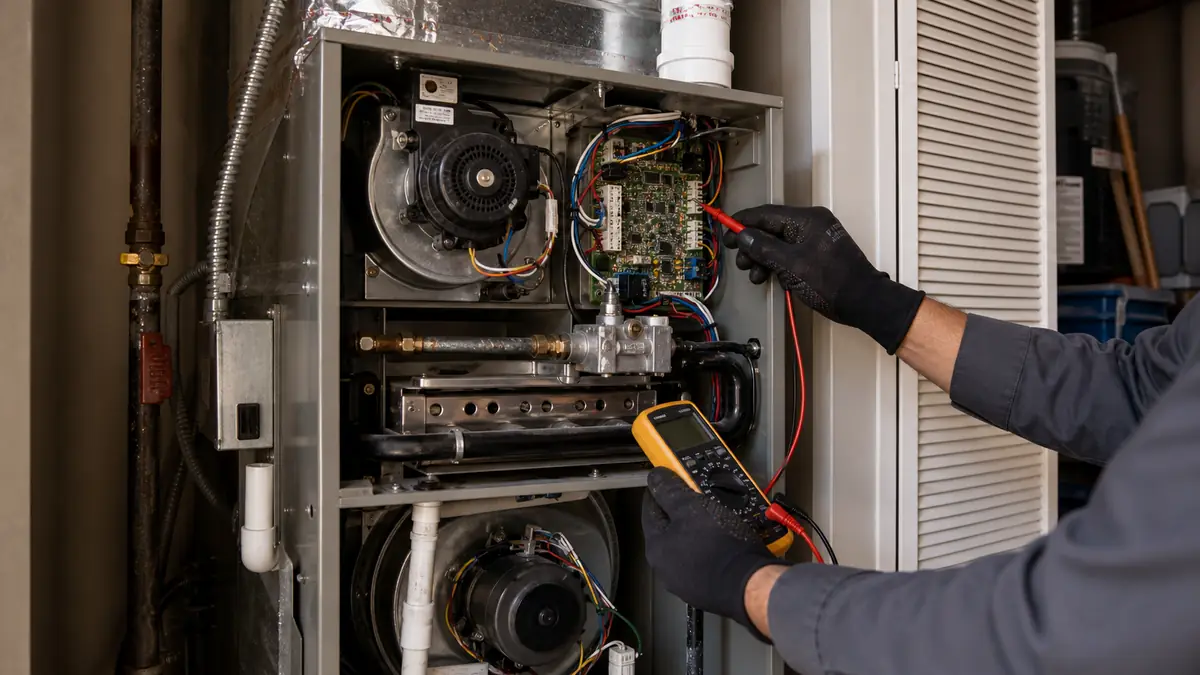
Most no-heat calls are the ignition train. A furnace that lights then drops out is a dirty flame sensor or weak hot-surface igniter -- Carrier stores that as code 34 or hard lockout 14. A pressure-switch fault is code 31, often a blocked vent or failing inducer. Limit-circuit lockouts (13, 33) trace back to restricted airflow from a clogged filter or a tired blower. A rollout-switch lockout (26) means we inspect the heat exchanger for cracks before doing anything else. The complete list is on the Carrier fault-code page, and the no-heat walkthrough is at furnace not heating.
| Code | Meaning / cause | Component | Cost lane |
|---|---|---|---|
| 34 / 14 | Ignition proving / hard ignition lockout | Flame sensor, hot-surface igniter | $150-$400 |
| 31 | Pressure switch did not close / reopened | Pressure switch, inducer, vent | $200-$700 |
| 13 / 33 | Limit-circuit lockout / fault (airflow) | Filter, blower, ductwork, limit switch | $150-$650 |
| 26 | Rollout switch open (safety) | Inspect heat exchanger; rollout switch | $200-$900+ |
| 24 / 45 | Control fuse open / control fault | Fuse, control/ignition board | $120-$2,000 |
| 44 | Excessive air-delivery restriction | Filter, duct, ECM blower | $129-$650 |
Installing or retrofitting a Carrier furnace in Glendale
A furnace swap in Glendale brings a few local wrinkles. The Ultra-Low NOx requirement steers model choice on many replacements, so we confirm the current air-district rule before quoting -- a like-for-like swap that ignores it will not permit. Condensing 59-series furnaces also need a condensate drain and proper venting, which an older home converting up from an 80% unit may not have, adding plumbing and flue work. Closet and attic furnaces in 1920s flatland homes can be tight on clearance and combustion air, and undersized return ducts limit how much airflow even a good furnace can move. We pull the City of Glendale mechanical permit on replacements. Where the furnace is failing and the home would benefit, we lay a heat-pump conversion alongside the like-for-like quote, since dropping gas combustion in Glendale's mild climate often makes long-term sense.
Furnace repair, replacement, or heat-pump conversion?
A single ignition or limit repair on a sound furnace is the easy call -- see Carrier furnace repair. A cracked heat exchanger or a furnace past 15-18 years is a replacement, and in Glendale's mild climate that is the moment to compare a like-for-like furnace against a Carrier heat pump conversion that covers cooling too. The buying guide works through that comparison, covering the Ultra-Low NOx rules and the caveat that the federal 25C credit has expired.
One Glendale-specific wrinkle weighs on the decision: because furnaces here run only a few weeks a season, a high-AFUE condensing unit recovers its premium slowly, so the efficiency math rarely favors the top tier on heating alone. A heat-pump conversion changes that calculus, since the same equipment also carries the long Zone 9 cooling load that a furnace cannot touch. We put the runtime numbers on the table rather than steering you to the most expensive box.
Common questions
Do I need a high-AFUE Carrier furnace in mild Glendale?
Not necessarily. Glendale's short heating season means a 96% AFUE 59TP6 pays back slower here than in a cold climate, so many homes do fine with a mid-tier condensing furnace. The bigger driver in California is the Ultra-Low NOx requirement, which steers model choice more than AFUE. We size to your actual runtime and budget, not the highest efficiency number.
What is an Ultra-Low NOx furnace and do I need one?
Ultra-Low NOx furnaces like the Carrier 59CU5 produce far lower nitrogen-oxide emissions and are required in many Southern California air districts for furnace replacements. When we quote a Glendale furnace swap, we confirm the current local requirement so the installed unit is compliant and permittable.
Why does my Carrier furnace keep locking out?
Repeat lockouts trace to the ignition train or a safety trip. Code 34 is an ignition-proving failure (often a flame sensor or igniter), 31 is a pressure switch or inducer issue, 13 and 33 are limit-circuit lockouts from restricted airflow, and 26 is a rollout switch that requires a heat-exchanger inspection. We read the stored code and fix the cause, not just reset the board.
Should I replace my old Carrier furnace or convert to a heat pump?
If the heat exchanger is cracked or the furnace is past 15-18 years, replacement is due. In Glendale's mild climate, converting to a Carrier heat pump is often the smarter long-term move since it also handles cooling and drops gas combustion -- worth comparing in our buying guide before you commit to a like-for-like furnace swap.