Emergency Carrier AC Repair in Glendale
Answer up front: Glendale Carrier HVAC runs same-day no-cool triage across Glendale, CA (91201-91208), prioritizing full Carrier AC failures during heat spells in Glenoaks Canyon, Adams Hill, and Downtown Glendale. Shut a struggling unit off first, then call (213) 772-7221 or book online and flag it as a complete no-cool.
Facts up front
- Same-day triage for full no-cool Carrier systems across 91201-91208.
- Heat-spell priority: Glenoaks Canyon and upper Verdugo Woodlands hold evening heat.
- Most emergency fixes are capacitor/contactor/fan motor -- carried on the truck.
- Diagnostic $129-$200; credited toward an approved same-visit repair.
- Saturday 8am-4pm standard rate; true after-hours quoted before we roll.
- Hours: Mon-Fri 7:30am-6:30pm, Sat 8am-4pm.
- Independent shop -- in-warranty units referred to a Carrier dealer first.
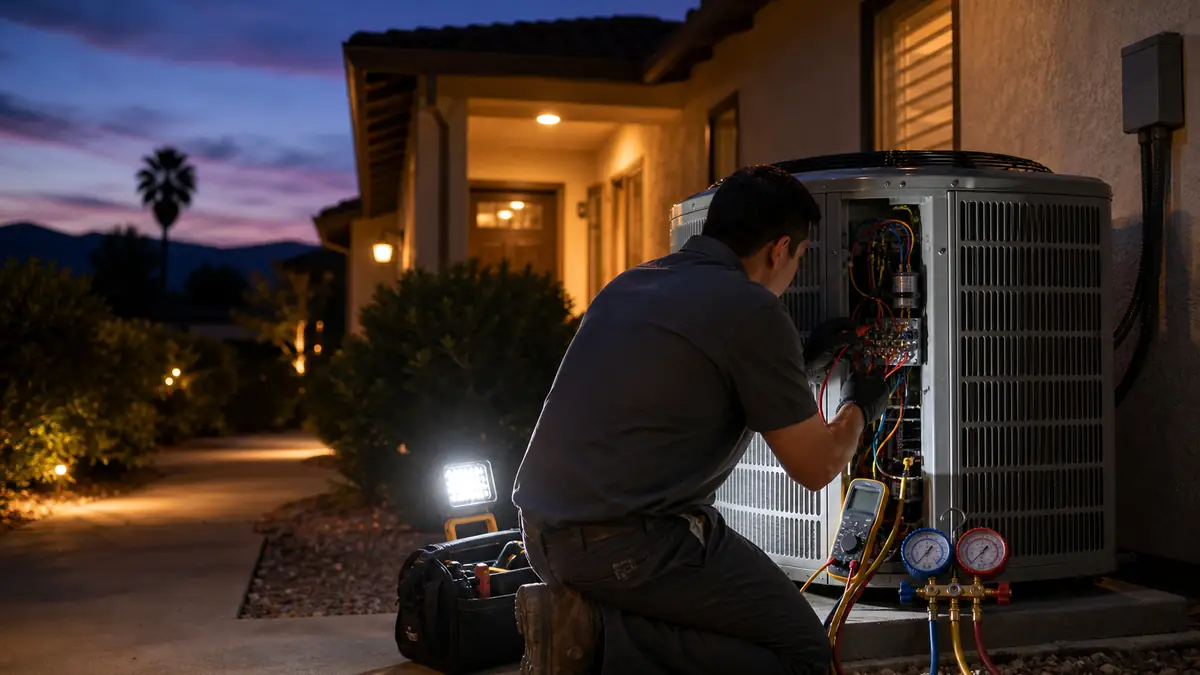
What should I do the moment my Carrier AC quits in the heat?
First, protect the compressor: switch the system off at the thermostat if it is humming without starting or if the indoor coil has frosted. Running a unit on a failed run capacitor or a low charge can weld the compressor windings and turn a same-day repair into a replacement. Second, check the breaker once -- if it trips again immediately, leave it off; that is an electrical fault we need to see. Then call the dispatch desk at (213) 772-7221 and describe the symptom and your cross streets so we can stage the right parts.
| What you see | First check / first move | Cost lane |
|---|---|---|
| Condenser hums, no start | Shut it off; likely capacitor/contactor | $150-$450 |
| Breaker keeps tripping | Leave breaker off; electrical fault | $129-$900 |
| Indoor coil iced solid | Off to thaw; low refrigerant or airflow | $225-$1,500 |
| Infinity reads System Malfunction | Note the 178/179 code; comm/board | $400-$2,000 |
| Water pouring from indoor unit | Off; clogged drain or condensate pump | $129-$450 |
| Burning or hot-plastic smell | Off at breaker; motor or wiring -- do not restart | $300-$2,000 |
How does an emergency Carrier call actually run?
Speed comes from staging the right parts before we roll, so the call follows a tight order. When you reach the dispatch desk we capture three things: the exact symptom (humming, tripping breaker, iced coil, water, smell), your cross streets so we can judge access and travel, and any code on the Infinity touchscreen if the system communicates. From that we load the truck -- common dual-run capacitors, contactors, a universal condenser fan motor, a hard-start kit, and refrigerant -- because roughly four out of five Glendale no-cool emergencies are one of those electrical parts. On site we go straight to the condenser, cut power, and meter the capacitor and contactor first, then check the fan motor and compressor windings; if those read good we put gauges on and check pressures for a refrigerant or airflow cause. You get a written price on the spot, and if it is a truck part we repair, restart, and confirm a normal temperature split before we leave. If it is an ordered part like an Infinity inverter board, we stabilize what we safely can and lock in the return timeline.
Which Carrier systems do you triage on emergency calls?
All of them, and the model changes how we approach the fault. On single-stage Comfort units (26SCA5, 26SCA4) and Performance units (26TPA8, 26SPA6) an emergency is almost always a straight electrical fault read with a meter -- capacitor, contactor, or fan motor -- which is why those repair on the spot. On a variable-speed Infinity (24VNA6, 26VNA1) or an Infinity heat pump (25VNA4, 27VNA3) the touchscreen narrows it fast: a 73 points at the run capacitor circuit, a 178 or 179 at communication wiring, and an outdoor or inverter alert at the variable-speed drive. Furnace no-heat emergencies on the 59-series boards read out as flash codes -- 14 hard ignition lockout, 31 pressure switch, 26 rollout -- and a rollout means we inspect the heat exchanger before re-firing anything.
What does an emergency repair cost in Glendale?
The diagnostic runs $129-$200 and is credited toward an approved same-visit repair, so you are not paying twice. The repair itself depends on the fault: a capacitor or contactor is $150-$450, a condenser fan motor $300-$900, a refrigerant leak repair with recharge $225-$1,500, and an Infinity board $400-$2,000. Saturday service from 8am to 4pm runs at standard rates; a true after-hours call outside posted hours can carry a premium, and we quote that rate before we drive out, never after. Nothing about an emergency changes our repair-vs-replace honesty -- if the no-cool turns out to be a dead compressor on a fifteen-year-old condenser, we say so and lay out the planned Carrier AC installation instead of selling you a band-aid.
How quickly can you reach my Glendale neighborhood?
We dispatch from inside Glendale, so flatland addresses near Brand Boulevard and the Galleria are usually a same-day reach when you call early. Foothill streets in Glenoaks Canyon, El Miradero, and Rossmoyne take a little longer for access but get the same heat-spell priority because those pockets stay hot into the evening. If every slot is full, we tell you honestly and book the next opening rather than stringing you along.
What if it turns out to be a bigger Carrier repair?
If the emergency is a worn capacitor or contactor, we fix it on the spot. If the diagnosis is a failed compressor, an Infinity inverter board, or a major refrigerant leak on an aging unit, we stabilize, give you a written price, and lay out repair versus a planned Carrier AC installation. For the underlying faults, the AC not cooling and fault-code pages explain what we are reading. Routine, non-urgent work is on the AC repair page.
Common questions
What counts as an AC emergency in Glendale?
A full no-cool with indoor temperatures climbing in a heat spell, a burning or electrical smell, a breaker that will not reset, or water pouring from an indoor unit. In Glenoaks Canyon and upper Verdugo Woodlands the evening heat does not let up, so we treat those no-cool calls as urgent even after the sun drops.
Should I keep running the AC while I wait for you?
No. If the condenser is humming without starting, or the indoor coil has iced over, shut the system off at the thermostat. Running a unit on a failed capacitor or low refrigerant can overheat the compressor and turn a $300 repair into a $2,600 one. Switch it off and call the dispatch desk.
Do you charge extra for after-hours or Saturday calls?
Saturday service runs 8am-4pm at standard rates. True after-hours emergency work can carry a premium, and we tell you the rate before we roll, never after. The diagnostic still applies, and once you approve the repair in the same visit, that fee comes off the total.
Can you fix it the same day or just diagnose it?
Most emergency faults in Glendale are a capacitor, contactor, or fan motor -- parts we carry on the truck -- so we often repair on the spot. If it needs an ordered part like an Infinity board, we stabilize what we can and give you a firm timeline rather than leaving you guessing.
How can I keep my Glendale home livable until you arrive?
Close blinds and curtains on the sun side, especially west-facing rooms in Glenoaks Canyon and El Miradero that bake into the evening, and run ceiling and box fans to keep air moving. Stay on the shaded, downhill side of the house if you can, and hydrate. If the indoor coil iced over, leaving the blower on fan-only after shutting off cooling helps it thaw faster before we get there.
Does an iced-up Carrier coil count as an emergency?
It is urgent but not dangerous. A coil iced solid means the system is starving for refrigerant or airflow, and running it that way risks slugging liquid back to the compressor and welding it. Shut cooling off, switch the fan to on so the ice melts, and call us. We then find why it iced -- a low charge from a flare leak, a clogged filter, or a failed blower -- rather than just thawing it and walking away.