Carrier Code 34 (Ignition Proving Failure) in Glendale
Answer up front: A Carrier code 34 in Glendale, CA (ZIP 91202) is an ignition-proving failure -- the burner lit but the board could not confirm flame, usually a dirty sensor. Most fixes run $150 to $400, so call (213) 772-7221 or book online and we restore reliable ignition.
Facts up front
- Code 34 = ignition proving failure: flame sensed, then lost.
- Top cause: a dirty or weak flame sensor reading too few microamps.
- Tell-tale: furnace lights for a few seconds, then shuts the gas.
- Flame-sensor clean or replace $150 to $400; gas-side faults higher.
- Spikes on Glendale's first cold nights after months of idle dust.
- Read it on the 59-series LED (3 short + 4 long) or Infinity screen.
- Hours: Mon-Fri 7:30am-6:30pm, Sat 8am-4pm. Phone: (213) 772-7221.
What does code 34 mean on a Carrier furnace?
Code 34 is an ignition-proving failure. Every time a Carrier 59-series furnace fires, it has to answer one question for itself: did the burner actually light? It answers using flame rectification. A flame-sensor rod sits directly in the burner flame, and because a flame conducts electricity in only one direction, a tiny direct current -- measured in microamps -- flows through the lit flame to ground. The control board watches for that current. If it sees enough, it keeps the gas valve open. If it does not see enough within a few seconds of opening the valve, it assumes there is no flame, closes the gas, and logs a 34. That whole sequence is a safety mechanism: the board would rather shut a perfectly good fire down than risk holding the valve open with no flame to burn the gas.
The catch is the word "enough." The board is not asking whether there is a flame; it is asking whether the current it reads clears its threshold. A flame can be burning beautifully while a dirty or weak sensor passes too little current to count -- and the board, blind to anything but that number, declares an ignition failure and shuts down. That is why a 34 so often turns out to be a five-dollar problem dressed up as a no-heat call. The flame was real. The signal was not strong enough to prove it.
How do you diagnose a Carrier code 34, step by step?
A 34 is diagnosed with a meter, because the whole fault is about a current reading. Here is how a call runs on a Glendale 59-series furnace:
- Confirm the code and watch a cycle. We count the LED flash (three short plus four long is 34) or read the Infinity touchscreen, then call for heat and watch the burners through the sight glass. Seeing the burner light and drop out in four to seven seconds confirms the flame-prove pattern over a true no-light.
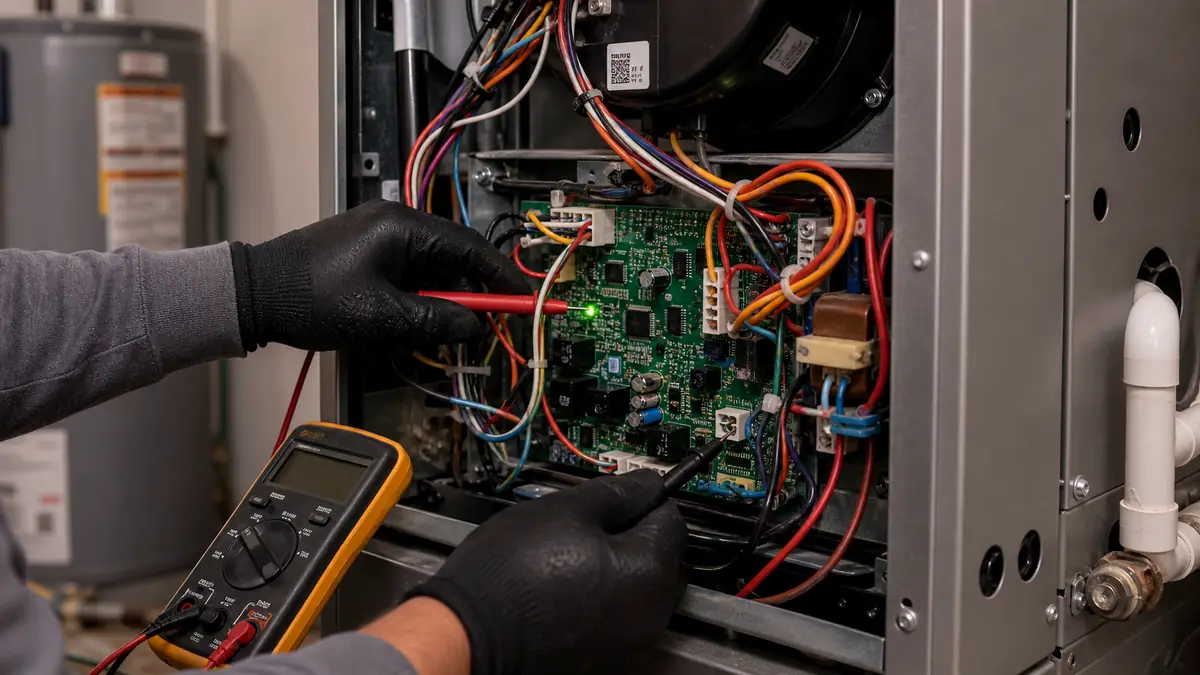
- Read the flame-sense microamps. We put a meter in series with the flame-sensor lead and read the DC microamp signal while the burner is lit. A healthy reading is usually a few microamps; a 59-series board typically wants to see at least roughly half a microamp to stay latched. A reading near zero with a visible flame is a dirty or failed sensor, full stop.
- Clean and re-read. We pull the sensor and lightly clean the oxide off the rod, then re-read the microamps. If the signal jumps back into range, that was the fault. If it stays low, the rod is replaced.
- Check the ground. Flame rectification needs a solid ground path. We verify the burner ground and the board ground, because a bad ground starves the signal exactly like a dirty rod and is a common miss.
- Inspect the igniter. If the burner is not lighting cleanly to begin with, a weak hot-surface igniter can leave a lazy flame the sensor cannot read. We confirm a strong, even glow and a crisp light-off.
- Meter the gas. If the sensor is clean, grounded, and reading low with a poor flame, we put a manometer on the gas valve to check manifold pressure and rule out a gas-supply or valve problem.
The microamp number is the heart of it. Once we have that reading before and after cleaning, the diagnosis is no longer a guess -- it is a measurement that tells us whether we just fixed it with a cleaning or whether the part has to come out.
Why does a Carrier furnace throw code 34 in Glendale?
The driver here is Glendale's short, late heating season working against an idle furnace. The city sits in Title-24 Climate Zone 9, tucked against the Verdugo Mountains, with localized hillside heat pockets that keep cooling running long into fall. By the time homeowners in Verdugo Woodlands, Montrose-adjacent streets, and Glenoaks Canyon finally call for heat, the furnace has sat untouched for months. During that idle stretch the flame-sensor rod slowly oxidizes and collects a film of dust, and the microamp signal it can pass quietly drops. The flame still lights on the first cold night -- but the weakened sensor can no longer prove it, and the board throws a 34. That is why ignition-proving calls cluster on the first genuinely cold evenings of the year, not in the dead of a cold snap.
Glendale's older housing adds a second layer. Many of the Spanish Colonial revival, Tudor, and Craftsman homes here have furnaces in dusty attics, closets, or basements where the burner compartment pulls in fine grit, which speeds up sensor fouling. Mid-century ranch homes and the newer hillside infill builds are not immune either -- any furnace that ran a long cooling season and then sat will load its sensor with the same film. Add the occasional gas-pressure dip after utility work in Downtown Glendale or a marginal igniter on an aging unit, and you have the full spread of what we see behind a 34 across these ZIP codes.
What can I safely check, and what should I leave to a pro?
The safe homeowner list on a 34 is short, because this fault lives at the burners and the gas valve. You can confirm the basics: make sure the thermostat is calling for heat, the furnace switch and breaker are on, the gas is on at the valve, and the furnace door is fully closed and latched. You can replace a dirty filter, since poor airflow can leave a weak, lazy flame the sensor struggles to read. If the furnace lights and drops out, note that pattern for the technician -- it is genuinely useful diagnostic information.
Cleaning the flame sensor is the one repair some handy homeowners attempt, and it is also where we ask for caution. Reaching it means opening the burner compartment next to the gas valve and live ignition components, and over-cleaning with coarse abrasive can ruin the rod's surface. There is no meter in a homeowner's hand to confirm the microamp signal actually recovered, so even a "successful" cleaning is a guess until the next cold night. Anything involving the gas valve, manifold pressure, the igniter, or repeated lockouts is firmly our work -- forcing a furnace through cycle after cycle of failed ignition pushes a little unburned gas into the burner box each time, and that is not a margin to play with. Clean filter, open gas, latched door: that is your lane. The microamp meter is ours.
What does a code 34 repair cost, and when is it urgent?
Most code 34 repairs in Glendale fall between $150 and $400, and the spread comes down to whether the sensor cleans up or has to be replaced and whether the cause turns out to be gas-side. A flame-sensor cleaning or a new sensor with a verified microamp reading is the low end. A weak hot-surface igniter replaced alongside it sits in the same general lane. The figure climbs only when the fault is genuinely on the gas side -- a partly failed gas valve is the costlier outcome, which is exactly why we confirm it with a manometer rather than throwing parts at it. A diagnostic visit to meter the flame signal is $129 to $200 and applies toward the repair.
On urgency, a 34 is a no-heat fault, so it climbs the priority list fast on a cold Glendale night even though the fault itself is usually minor and safe. The furnace shuts the gas off on its own, so there is no leak risk from a single lockout -- the danger is purely comfort and the temptation to keep resetting it. Our guidance is plain: reset it once to confirm the light-then-drop pattern, and if 34 comes right back, stop and book service instead of cycling it repeatedly. If you also want the broader picture, the Carrier fault-code reference maps 34 against its neighbors like 14 and 31, and the furnace not heating page covers the whole cold-air scenario. When a sensor or igniter is the verdict, our Carrier furnace repair page explains how we handle it on Glendale 59-series units.
Common questions
What is the fastest fix for a Carrier code 34?
The fastest fix is cleaning the flame sensor, which clears the majority of 34s. The sensor is a thin metal rod that sits in the flame and passes a tiny microamp current to prove the burner lit. A film of oxide or dust insulates it, the current drops below the board's threshold, and the furnace shuts the gas as a safety. A two-minute cleaning often restores the signal -- though if the rod is corroded through, it gets replaced.
Why does my Carrier furnace light then shut off after a few seconds?
That light-then-drop pattern is the signature of code 34. The igniter glows, the gas valve opens, the burner lights -- and then the board fails to sense enough flame current and closes the gas within about four to seven seconds. You see a brief flame through the sight glass, then nothing. It almost always means a dirty or weak flame sensor, occasionally a marginal gas supply or a bad ground.
Can a code 34 be a gas problem instead of the sensor?
Yes, and we rule it out. If the flame sensor is clean and well grounded but the burner still will not stay lit, the next suspects are gas-side: low gas pressure, a partly failed gas valve, or air in the line after utility work. We put a manometer on the valve to read manifold pressure. Gas-side faults are less common than a dirty sensor but more serious, so we confirm with a gauge rather than guess.
Is it safe to keep resetting a furnace on code 34?
Resetting once to confirm the pattern is fine. Repeatedly cycling it is not a good idea. Each failed attempt dumps a small charge of unburned gas into the burner box before the valve closes, and forcing cycle after cycle stresses the board and the igniter. If 34 comes back after one reset, leave it off and book service rather than retrying it a dozen times.