Carrier Furnace Repair in Glendale
Answer up front: Glendale Carrier HVAC repairs Carrier gas furnaces across Glendale, CA (91201-91208), from Downtown Glendale to Rossmoyne, fixing flame sensors, hot-surface igniters, pressure switches, inducers, and 59-series lockout codes like 13, 14, 31, and 34, with most repairs running $150-$2,000; call (213) 772-7221 or book online for a diagnosis.
Facts up front
- Covers Carrier 59-series (59MN7, 59TN, 59TP, 59SC) and 58-series 80% furnaces.
- Most common no-heat cause: dirty flame sensor or weak igniter, $150-$300.
- Reads lockout codes 13, 14, 26, 31, 33, 34, 45 at the board.
- Pressure switch, inducer, or gas-valve work: $200-$900.
- Control/ignition board: $400-$2,000.
- Hours: Mon-Fri 7:30am-6:30pm, Sat 8am-4pm.
- Independent shop -- in-warranty units referred to a Carrier dealer first.
Why won't my Carrier furnace stay lit in Glendale?
The most common no-heat pattern -- furnace lights, runs a few seconds, then shuts off -- is a dirty flame sensor or a tired hot-surface igniter failing to prove flame, which locks the board out on safety. On Carrier 59-series furnaces that often stores as code 34, ignition proving failure, or code 14, a hard ignition lockout. Because Glendale winters are short, these furnaces sit idle for months and then get asked to fire on the first cold night with a dust-caked sensor; that is why no-heat calls cluster in the first cold weeks. A flame-current reading tells us whether it is a cleaning, a sensor, or an igniter.
| Symptom / code | Likely cause / first check | Cost lane |
|---|---|---|
| Lights, drops out (code 34/14) | Flame sensor or hot-surface igniter | $150-$400 |
| No ignition, code 31 | Pressure switch / inducer / vent blockage | $200-$700 |
| Limit lockout, code 13/33 | Restricted airflow; filter, blower, ducts | $150-$650 |
| Rollout lockout, code 26 | Inspect heat exchanger (safety) | $200-$900+ |
| No call response, code 24/45 | Control fuse or board fault | $120-$2,000 |
| Runs but weak heat, code 44 | Air-delivery restriction; filter/duct/blower | $129-$650 |
| Cold air, blower runs constantly | ECM blower or fan-limit control | $300-$2,300 |
How does a Carrier furnace repair go, step by step?
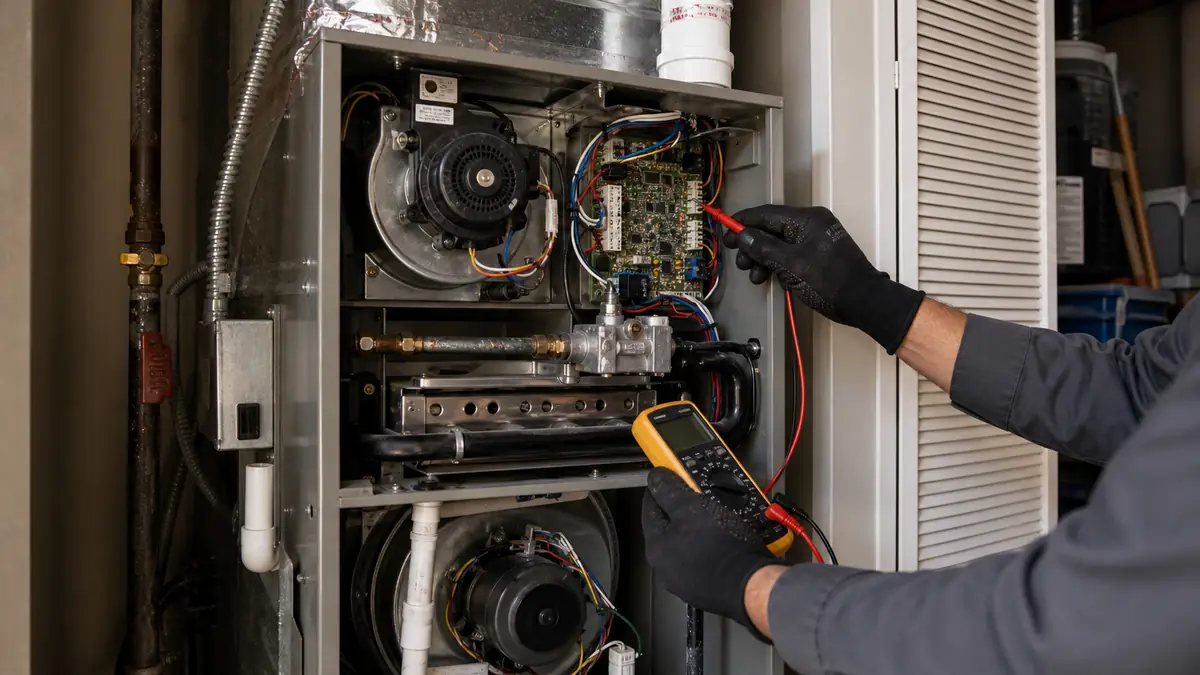
A no-heat diagnosis follows the ignition sequence in order, the same way the furnace itself tries to fire. First we read the stored code from the amber LED on the 59-series board (short flashes then long flashes -- three short plus four long is a 34) or the plain-language text on an Infinity touchscreen. Second, we watch a full call for heat: the inducer should start and prove the pressure switch, the hot-surface igniter should glow, the gas valve should open, flame should establish, and the flame sensor should prove it. Whichever step fails is where the fault lives. Third, we test the suspect component -- a microamp flame-current reading on the flame sensor (a weak signal is the classic dirty-sensor fault behind code 34), continuity on the igniter, the pressure-switch closure against inducer draft, and the high-limit and rollout switches. Fourth, a written price. Fifth, the fix and verification: we re-fire, confirm clean ignition and a steady flame signal, check the temperature rise across the heat exchanger is within the nameplate range, and clear the stored code.
The instruments keep it honest: a multimeter for continuity and microamps, a manometer for gas and draft pressures, and a combustion-aware eye on the flame and the heat exchanger. We do not just reset a locked-out board and leave -- a code 13 or 33 limit lockout is a symptom of restricted airflow, so we chase the dirty filter, failing blower, or closed-down duct that caused it.
Which Carrier furnace models do you repair in Glendale?
The whole 59- and 58-series lineup. The condensing 59-series runs from the flagship 59MN7 (Infinity 98) with its modulating gas valve and variable-speed ECM blower, down through the two-stage 59TN7 and 59TN6 (Infinity 97/96), the Performance 59TP6, and the single-stage Comfort 59SC6. The Ultra-Low NOx 59CU5 (Infinity 95) matters in California because many local air districts require Ultra-Low NOx models on replacement. The 58-series 80% furnaces -- 58TN, 58TP, 58SC -- remain common and sensible in Glendale's short heating season. The repair difference across the line is the blower and gas control: a single-stage 58-series or 59SC6 is a straightforward board-and-ignition diagnosis, while the 59MN7 and 59TN units add a variable-speed ECM and a modulating or two-stage valve that the Infinity control stages, so faults can surface as numeric codes alongside the LED flashes.
What does furnace repair cost in Glendale and why?
The band is $150-$2,000, and the part decides where you land. The most common no-heat fix -- cleaning or replacing a dirty flame sensor or a weak hot-surface igniter -- is $150-$300, mostly labor since the parts are inexpensive. A pressure switch, inducer motor, or gas-valve repair is $200-$900. A limit or rollout issue is usually cheap to fix once we clear the underlying airflow restriction, in the $150-$650 range. The big-ticket items are a control or ignition board at $400-$2,000 and a variable-speed ECM blower module or motor at $450-$2,300 on the 59MN7-class units. The diagnostic is $129-$200, credited toward an approved repair. The Glendale-specific driver is timing: furnaces sit idle through the long cooling season, so the first cold week produces a cluster of dirty-sensor and dust-fouled-igniter calls that a pre-winter check would have headed off.
What do the Carrier furnace lockout codes tell you?
Carrier 59-series boards flash a numeric code that points the diagnosis: 13 is a limit-circuit lockout, 31 a pressure switch that did not close or reopened, 33 a limit-circuit fault, 34 an ignition-proving failure, 26 a rollout switch, and 24 or 45 a control-fuse or circuitry fault. We read the stored code, then verify the actual cause -- a code 13 or 33 limit lockout, for instance, is usually a symptom of restricted airflow from a clogged filter or failing blower, not a bad limit switch. The full reference is on the Carrier fault-code page; for the no-heat walkthrough see furnace not heating.
When is it time to replace the furnace?
A rollout lockout (code 26) on a furnace past 15 years means we inspect the heat exchanger directly, and a cracked one is a safety red-tag, not a repair. At that point we weigh a 59-series Carrier gas furnace replacement -- California requires Ultra-Low NOx models in many cases -- against a heat-pump conversion that drops gas heat entirely. For a sound furnace, a single repair plus a maintenance habit is the right call; the maintenance calendar lays out the pre-winter checks.
Common questions
My Carrier furnace lights then shuts off after a few seconds -- why?
That short-flame pattern is almost always a dirty flame sensor or a weak hot-surface igniter. The furnace lights, fails to prove flame, and locks out on safety. On 59-series Carrier furnaces you may see code 34 (ignition proving failure). Cleaning or replacing the flame sensor is a low-cost fix in the $150-$300 range; we confirm with a microamp flame-current reading.
What do Carrier furnace codes 13, 31, or 33 mean?
On Carrier 59-series boards, 13 is a limit-circuit lockout, 31 is a pressure switch that did not close or reopened, and 33 is a limit-circuit fault -- often from restricted airflow or an inducer or vent problem. Code 26 is a rollout switch, which means we must inspect the heat exchanger. We read the stored code and trace the actual cause before quoting a part.
Do Glendale furnaces really get much use?
Less than the AC, but the mild winters fool people into skipping maintenance, so the furnace sits idle then gets asked to run on the first cold snap with a dust-caked igniter and sensor. That is why most no-heat calls cluster in the first cold weeks of the season. A pre-winter check on the 59-series ignition train heads off most of them.
Is a cracked heat exchanger a real risk on older Carrier furnaces?
It can be on furnaces past 15 years, and a rollout-switch lockout (code 26) is a red flag. A cracked heat exchanger can leak combustion gases, so we inspect it directly and will red-tag a unit that is unsafe rather than patch around it. On an older furnace that is often the point to weigh a 59-series replacement or a heat-pump conversion.
How long does a Carrier furnace repair take?
Most no-heat calls are a single visit. Cleaning or replacing a flame sensor or hot-surface igniter is under an hour, a pressure switch or inducer motor runs one to two hours, and a control board is similar once the part is on hand. The only second-trip jobs are an ordered board or gas valve, or a heat-exchanger inspection that turns up a crack and shifts the conversation to replacement.
Why does my Carrier furnace smell when it first runs each winter?
A faint dusty or burning smell on the first fire of the season is usually dust burning off the heat exchanger and igniter after months idle -- normal in Glendale, where furnaces sit unused through the long cooling season, and it should clear in a few minutes. A persistent burning-plastic or sharp electrical smell is not normal: shut it off and call us, since that points to a motor, wiring, or board problem rather than seasonal dust.