Carrier Code 33 (Limit Circuit Fault) in Glendale
Answer up front: A Carrier code 33 in Glendale, CA (ZIP 91201) is a high-limit lockout -- the 59-series furnace overheated on low airflow and shut off on its safety. Most fixes run $150 to $650, so call (213) 772-7221 or book online and we trace the airflow cause, not just the switch.
Facts up front
- Code 33 = high-limit circuit fault from recurrent overheating.
- Root cause 9 times out of 10: restricted airflow, not a bad switch.
- First check: filter, then every supply and return register.
- Airflow repair $150 to $600; a failed limit switch $150 to $350.
- Common in Glendale's Craftsman and Tudor homes with retrofit ducts.
- Read it on the 59-series LED (3 short + 3 long) or Infinity screen.
- Hours: Mon-Fri 7:30am-6:30pm, Sat 8am-4pm. Phone: (213) 772-7221.
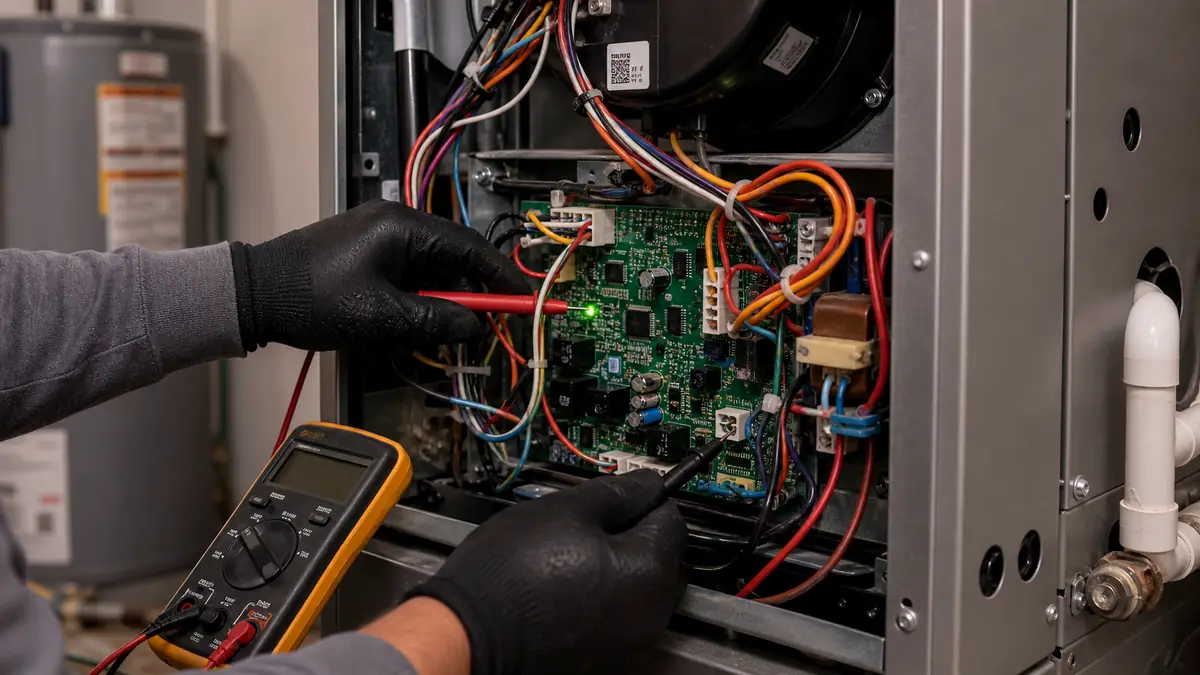
What does code 33 mean on a Carrier furnace?
Code 33 is a limit-circuit fault. Inside a Carrier 59-series gas furnace sits a high-limit switch -- a temperature-sensitive disc bolted to the heat-exchanger plenum. When the air moving across the heat exchanger is too slow, the metal runs hotter than the switch's rated setpoint, the disc opens, and the board cuts the burners. The control logs that event as a 33. It is not telling you the switch is broken; it is telling you the furnace got too hot to run safely. The switch is the messenger, and on most Glendale calls it is doing exactly what it should.
That distinction drives everything we do on a 33. A homeowner who swaps the limit switch and resets the board has changed the messenger and left the message. The furnace will overheat again on the next long cycle and lock right back out. The real question a 33 asks is simple: why can't this furnace shed its heat? Nearly always the answer is airflow -- something is choking the volume of air the blower can push across that hot heat exchanger. We treat code 33 as an airflow investigation first and an electrical repair second, and that order is what keeps the fix from coming back.
Why does a Carrier furnace overheat in Glendale homes?
Glendale's housing stock is a big part of the story. A lot of the heating systems here are squeezed into Spanish Colonial revival, Tudor revival, and Craftsman houses across Adams Hill, Rossmoyne, and Verdugo Woodlands -- homes that were never designed around a modern forced-air furnace. When a high-efficiency Carrier unit gets dropped into a closet or a tight attic in one of these older houses, it often inherits undersized or kinked return ducts. The furnace can produce the heat just fine; it simply cannot get enough return air back across the heat exchanger to carry that heat away. That chronic airflow shortfall is the classic setup for a recurring 33.
The everyday causes stack on top of that. A filter that has not been changed since spring is the number-one trigger -- and because Glendale's cooling season is long and dusty, filters here load up fast against fine Verdugo Wash and roadway grit. Closed or blocked registers are next; a homeowner who shuts vents in unused bedrooms to "save energy" starves the system and trips the limit. Then come the mechanical causes: a blower wheel caked with dust that no longer moves its rated airflow, a failing ECM blower motor slowing under load, or a collapsed flex duct in a hot Glenoaks Canyon attic. Each one does the same thing -- it drops airflow across the heat exchanger until the metal overheats and the limit opens.
Climate sharpens the pattern. Glendale sits in Title-24 Climate Zone 9, and the Verdugo Mountains and Verdugo Wash create localized hillside heat pockets. The heating season is short, so a furnace can sit unused for months, collect dust on the blower and filter, and then get asked to run long cycles on the first genuinely cold mornings. That combination -- idle months, then long runtime against a quietly clogged filter -- is why our December and January 33 calls cluster the way they do.
How do you diagnose a Carrier code 33 step by step?
We work the airflow path from the room back to the heat exchanger, with instruments, because a 33 is a measurement problem, not a guess. The walkthrough on a Glendale call usually runs like this:
- Read the board and the history. On a non-communicating 59-series furnace we count the amber LED flash (three short plus three long is 33) and check whether 13 or other limit codes are stored alongside it. On an Infinity communicating system we pull the stored fault history off the touchscreen to see how often it has tripped and on what runtime.
- Inspect the filter and registers. We pull the filter and look at it against light -- a loaded filter is the single most common cause -- and confirm every supply and return register is open and unobstructed. This is the cheapest fix on the list and we rule it in or out first.
- Measure temperature rise. With a probe in the supply and return plenums we read the temperature rise across the heat exchanger and compare it to the rating-plate spec (commonly 35 to 65 degrees F). A rise above the listed range is hard proof of low airflow -- the air is overheating because too little of it is moving.
- Check static pressure. A manometer reading total external static pressure tells us whether the duct system itself is the choke point. High static in an older Adams Hill or Rossmoyne house usually means undersized returns or a crushed duct, not a furnace fault.
- Inspect the blower. We look at the blower wheel for a dust cake and confirm the motor spins up to speed under a heat call; a dragging ECM or a fouled wheel both cut airflow measurably.
- Test the limit switch last. Only after airflow checks out do we meter the high-limit switch for continuity and verify it opens and closes at its rated temperature. A switch that opens early -- below its setpoint -- is the rare case where the switch itself is genuinely at fault.
By the time we reach step six we usually already know the answer, because the temperature-rise and static numbers have pointed straight at the restriction. Naming the part without those readings is how a 33 comes back two weeks later.
What can I safely check myself before calling a pro?
There is a short, safe list a Glendale homeowner can run before booking, and it solves a real share of 33s outright. Replace the air filter if it is dirty -- match the size and arrow direction printed on the frame, and do not jump to a thick high-MERV filter on a system that was not set up for it, because that can cause the very restriction you are trying to cure. Walk the house and open every supply and return register, including the ones in rooms you keep closed. Make sure furniture, rugs, or boxes are not sitting on a floor return. Confirm the furnace door is fully latched, since the door switch and airflow path both depend on it.
Stop there. Anything past the filter and registers means opening the furnace cabinet, and a 33 lives right next to the burners, the heat exchanger, and 24-volt safety wiring. Pulling or jumpering a limit switch to force the furnace to run defeats the one device protecting the heat exchanger from a crack, and that is exactly the failure that turns a $200 repair into a combustion-safety problem. Measuring temperature rise, static pressure, and switch continuity calls for instruments and the training to read them. If the filter is clean, the registers are open, and 33 still shows up, that is the line where it becomes our job.
What does fixing a code 33 cost in Glendale, and when is it urgent?
The cost tracks the cause, which is why we diagnose before we quote. Most code 33 repairs land between $150 and $650 in the Glendale area. An airflow fix -- a fresh filter, a cleaned blower wheel, a repaired or replaced section of crushed flex duct -- generally runs $150 to $600. A high-limit switch that has genuinely failed and opens below its setpoint is roughly $150 to $350 installed. A failing ECM blower motor sits higher, since the motor itself is the expensive part. A diagnostic visit to read the temperature rise and static pressure is $129 to $200 and gets credited toward the repair when we do the work.
On urgency: a single 33 on a mild day is not an emergency, but it is not something to ride out either. The reason is the heat exchanger. Every time the furnace overheats and resets, that steel cycles through a thermal stress it was not meant to take repeatedly, and over a season of ignored 33s you can crack it. A cracked heat exchanger is a carbon-monoxide concern and a replacement, not a patch. So the practical rule we give Glendale customers is this: if 33 shows up once and a filter change clears it, you are fine; if it keeps coming back, stop resetting it and book service before the airflow problem damages the exchanger. For the full code map see our Carrier fault-code reference, and if the furnace is also blowing cold air, the furnace not heating walkthrough covers the ignition side. When the diagnosis points at the heat exchanger or a tired unit, our Carrier furnace repair page lays out repair-versus-replace.
Common questions
Is a Carrier code 33 dangerous?
On its own, no -- the high limit is the safety doing its job, cutting the burners before the heat exchanger overheats. The risk comes from ignoring it. A furnace that overheats and resets all winter cooks its heat exchanger, and a cracked exchanger can leak combustion gases. Fixing the airflow cause behind a 33 protects that exchanger, so it is worth booking rather than repeatedly resetting.
Can I clear a code 33 myself?
You can cut power for a minute to clear the soft lockout, but if the filter and registers are not the cause it will trip again within a cycle or two. Change a clogged filter and open every supply and return register first. If 33 returns after that, the blower, ductwork, or the limit switch itself needs a meter, and that is our call.
Why does my Carrier furnace throw code 33 only on cold mornings?
Cold Glendale mornings are when the furnace runs its longest cycles, so a marginal airflow restriction that stays hidden on a mild day finally pushes the heat exchanger past the limit setpoint. A filter that was merely dirty in October becomes a hard restriction by a January morning in Rossmoyne or Glenoaks Canyon. Long runtime plus restriction equals a 33.
How is code 33 different from code 13?
They are close cousins on Carrier 59-series boards. Code 13 is a limit-circuit lockout after repeated trips, while 33 is logged as the limit-circuit fault that gets you there. In practice both point at the same root causes -- restricted airflow from a filter, blower, or duct problem -- and we chase them the same way: confirm airflow first, then test the switch.