Carrier AC Repair in Glendale
Answer up front: Glendale Carrier HVAC repairs Carrier air conditioners across Glendale, CA (91201-91208), from Adams Hill to Rossmoyne, covering capacitors, contactors, condenser fan motors, refrigerant leaks, and code 44 airflow restrictions, with most repairs landing between $129 and $1,500; call (213) 772-7221 or book online for a same-week diagnosis.
Facts up front
- Covers Carrier Infinity, Performance, and Comfort condensers across 91201-91208.
- Most common Glendale AC fault: failed run capacitor or contactor, $150-$450.
- Refrigerant leak repair + recharge: $225-$1,500 (R-410A ~$50-80/lb installed).
- Condenser fan or ECM blower motor: $450-$2,300.
- Diagnostic visit $129-$200, credited toward an approved repair.
- Hours: Mon-Fri 7:30am-6:30pm, Sat 8am-4pm.
- Independent shop -- in-warranty units referred to a Carrier dealer first.
What usually breaks on a Carrier AC in Glendale?
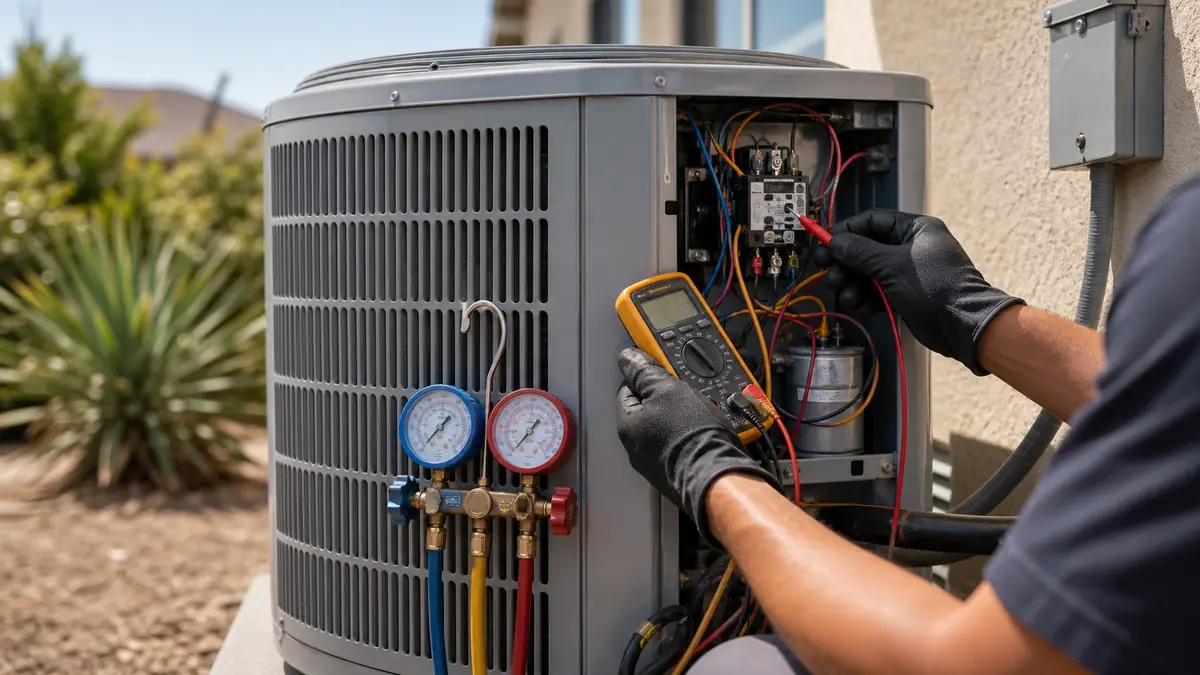
By a wide margin, the dual-run capacitor and the contactor. They take the brunt of Glendale's 35-50 days a year above 90 F, and the electrical inrush every time the compressor starts. When a Carrier condenser hums but the fan and compressor sit dead, that pair is the first suspect. On communicating 24/25-series units you may see code 73 -- voltage sensed at the cap with no compressor completing the call. We read microfarads on the capacitor, inspect the contactor for pitting, and check the compressor windings before quoting.
After electrical, the next tier is refrigerant and airflow. A slow leak at a flare joint or the evaporator drops capacity, ices the indoor coil, and stretches run times; Carrier flags severe air-delivery restriction as code 44 and suction-sensor trouble as code 54. The all-important first check is the filter and coil -- on dense Downtown Glendale lots the condenser often sits in a hot, lint-choked side yard. We clear airflow first, then pressure-test for an actual leak rather than just topping off a system that will be empty again by August.
| Symptom | Likely cause / first check | Cost lane |
|---|---|---|
| Hums, fan and compressor dead | Run capacitor or contactor (code 73 on some 24/25 units) | $150-$450 |
| Runs but barely cools, coil icing | Low refrigerant leak; pressure-test before recharge | $225-$1,500 |
| Long run times, code 44 | Dirty filter/coil or duct restriction; airflow first | $129-$400 |
| Outdoor fan not spinning, hot unit | Condenser fan motor or its capacitor | $300-$900 |
| Weak airflow at registers, ECM fault | Variable-speed blower module or motor | $450-$2,300 |
| Infinity reads code 54 or 56 | Suction or outdoor-air/coil thermistor out of range | $200-$500 |
| System Malfunction, code 178/179 | A-B-C-D comm wiring or control board | $129-$2,000 |
How does a Carrier AC repair visit actually go?
We work the same diagnostic order every time so nothing gets skipped or guessed. First the intake: you describe the symptom and we check the thermostat call and the Infinity touchscreen fault history if the system communicates. Second, the electrical bench check at the condenser -- we cut power, read the dual-run capacitor against its rated microfarads with a meter, inspect the contactor points for pitting or welding, and check the compressor windings and the condenser fan motor. Third, the refrigerant and airflow side -- gauges on the service ports to read suction and head pressure and superheat or subcooling, plus the filter, evaporator coil, and return ducting. Fourth, we name the finding and hand you a written price before any part goes in. Fifth, the fix and the verification: after the repair we restart the system, confirm a normal temperature split across the coil (roughly 16-22 F return-to-supply), recheck pressures, and clear any stored code on the Infinity control.
The instruments matter because they keep the diagnosis honest. A multimeter and a clamp ammeter settle the electrical questions, a micron gauge and a recovery machine handle any refrigerant work properly, and the temperature split is the final proof the system is actually cooling and not just running. On a tight Downtown Glendale lot we also clear the condenser's airflow path before condemning any part, since a unit baking against a fence reads like a dozen other faults.
Which Carrier AC models do you repair in Glendale?
The full residential lineup, across all three tiers. On the Comfort value tier we see the single-stage 26SCA5 (Comfort 16) and 26SCA4 (Comfort 14) -- straightforward 24-volt units where the capacitor and contactor are the usual repairs. The Performance tier brings the two-stage 26TPA8 (Performance 18) and single-stage 26SPA6 (Performance 16), with the coastal-protected 26TPA8 variants showing up on canyon-edge homes. The Infinity tier is the Greenspeed flagship: the 26VNA1 (Infinity 21) and the recent 24VNA6 (Infinity 26), which modulate the compressor 25-100 percent and depend on the Infinity System Control. The practical difference for a repair is the diagnostic path: Comfort and Performance units are read electrically with a meter, while an Infinity unit also surfaces numeric codes -- 44 for airflow restriction, 54 and 56 for sensor faults, 178 and 179 for communication -- on its touchscreen, which speeds the diagnosis but raises the cost of a board or inverter replacement.
What does AC repair cost in Glendale and why?
The headline band is $129 to $1,500 for most repairs, and the spread comes down to which sub-job you land in. The diagnostic visit is $129-$200 and is usually credited toward an approved repair. The single most common Glendale fix -- a failed dual-run capacitor or pitted contactor -- runs $150-$450, where the part is cheap and most of the cost is the trip and labor. A condenser fan motor with its own capacitor is $300-$900. Refrigerant work is the wide one: a leak search runs $100-$330, and recharge adds R-410A at roughly $50-80 per pound installed, so a real leak repair plus recharge lands anywhere from $225 to $1,500 depending on the leak location and how much charge walked out. A variable-speed ECM blower module or motor is $450-$2,300, and an Infinity communicating or inverter board is $400-$2,000. The cost drivers in Glendale specifically are condenser access on cramped flatland side yards, the rising price of R-410A as the refrigerant phasedown continues, and the premium parts on the Infinity tier.
How fast can you repair an AC during a Glendale heat wave?
Calls placed before early afternoon usually get a same-week slot, and full no-cool failures during a 95 F-plus stretch are bumped to the soonest opening. The canyon pockets in Glenoaks and upper Verdugo Woodlands hold heat into the evening, so we treat those no-cool calls as urgent. If your system is fully down, see the emergency AC repair page and tell the dispatch desk it is a complete no-cool.
Do you handle Carrier refrigerant and coil work?
Yes. We pressure-test for leaks, repair flare and braze joints, evacuate, and recharge to the nameplate. R-410A runs roughly $50-80 per pound installed, and with the refrigerant phasedown, chasing leaks on an aging Performance or Comfort unit gets pricier each year -- a factor we put on the table when a system is past a decade. Dirty Spine-style coils and clogged condensate drains get cleaned the same visit. If the unit reads an Infinity comm fault instead, that points at the Infinity System Control or board, covered under codes 178/179.
Repair or replace this Carrier AC?
A few-hundred-dollar fix on a condenser still shy of ten years gets repaired, no question. The line shifts once the unit sits in the 10-to-12-year window and the repair would eat half of what a fresh system costs -- or once the unit's age times the repair price clears about $5,000 -- and at that point replacing it is the straight answer. We tell you which side of that line your Glendale unit lands on and price a right-sized Carrier AC installation only when it earns its place. The buying guide lays out the full math.
Common questions
Why does my Carrier AC keep blowing the run capacitor in summer?
In Glendale's Zone 9 heat, a capacitor that fails every season usually means it was undersized for the load or the condenser is running hot from a dirty coil or a side-yard with no airflow -- common on tight Adams Hill lots. We measure the capacitor's microfarads, check the contactor, and clean the coil rather than just swapping the part and waiting for it to cook again.
My Carrier shows code 73 -- what does that mean?
Code 73 on some 24- and 25-series Carrier condensers means the board senses voltage at the run capacitor but no compressor call is completing -- typically a contactor, capacitor, or compressor-circuit problem. It is an electrical diagnosis, not a refrigerant one. We confirm with meter readings before quoting; the fix usually sits in the $150-$450 lane.
Is it worth repairing a 13-year-old Carrier condenser in Glendale?
It depends on the fault. A $200 capacitor on a 13-year-old Comfort 14 is reasonable; a $2,600 compressor on the same unit is not. Our test in Glendale: if the unit has already passed 10-12 years and the fix would cost about half of a new system, a replacement usually wins out, all the more so as R-410A recharge prices climb each season.
Do you charge to diagnose an AC that will not cool?
Yes. The diagnostic visit in Glendale sits in the $129-$200 lane, and once you sign off on the repair that same visit, that fee comes off the repair total. The written price lands before any part goes in, so the invoice holds no surprises in Rossmoyne or Verdugo Woodlands.
How long does a typical Carrier AC repair take in Glendale?
Most calls are done in one visit. A capacitor or contactor swap is 30-60 minutes once we confirm the reading; a condenser fan motor runs an hour or two; a refrigerant leak repair with evacuation and recharge can take half a day. Only an ordered part -- an Infinity board or a warranty compressor -- pushes the job to a second trip, and we tell you that timeline before we leave.
What is the difference between repairing a Comfort, Performance, and Infinity AC?
The electrical wear items are the same across all three Carrier tiers, so a capacitor or contactor on a Comfort 26SCA4 costs the same as on an Infinity 24VNA6. The difference shows up on board and compressor faults: a single-stage Comfort or Performance unit is straight 24-volt diagnosis, while an Infinity variable-speed unit adds the communicating control and inverter board, which read out as numeric codes but cost more to replace.